Info
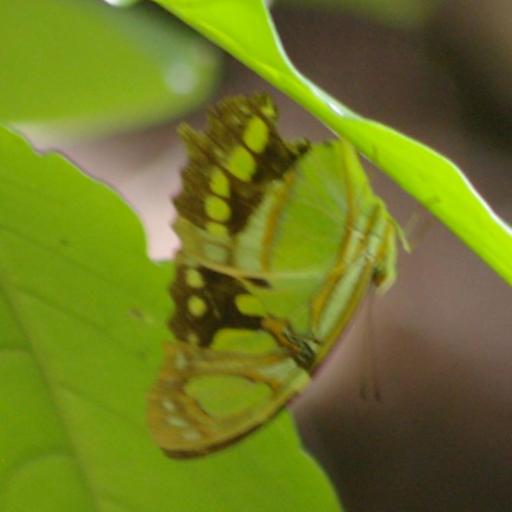
Named after the translucent green gemstone, the Malachite butterfly (Siproeta stelenes) looks like a living stained-glass window flitting through the trees. Often mistaken for the "Bamboo Page" butterfly, it is a common yet breathtaking sight in subtropical gardens from Florida down to the Amazon. It is famous for its slow, graceful flight and its tendency to land on sun-drenched leaves to "bask."
🔍 How to Identify
- 🎨 Stained-Glass Wings: Large, dark brown to black wings featuring brilliant, translucent pale green or yellow-green patches that seem to glow when backlit.
- 🦋 Under-Wing Camouflage: The underside is a muted mix of light brown and pearly, silvery-green, helping it blend into dried leaves and bark when resting with wings closed.
- ✂️ Scalloped Edges: The wing margins are notably notched or "toothed," giving the butterfly a complex, jagged silhouette rather than a smooth curve.
🌲 Habitat & Ecology
- 🍎 A Sweet & Savory Diet: While it does visit flowers, the Malachite is a frequent visitor to "messier" food sources. You will often find them congregating around piles of fermenting fruit, tree sap, and even bird droppings to gain essential minerals.
- 🌿 The Wild Petunia Connection: These butterflies are usually found near their favorite "nursery" plants. Their spiky, black caterpillars feed almost exclusively on plants in the Acanthaceae family, particularly the Wild Petunia (Ruellia).
⚠️ Safety & Toxicity
- ✅ Harmless Beauty: The Malachite is a "friend" in every sense. It possesses no stingers, does not bite, and does not carry any diseases harmful to humans.
- 🐾 Non-Toxic: Unlike the Monarch, which is toxic to predators due to its diet, the Malachite is generally non-toxic. It is perfectly safe for pets and children to observe in the garden.
✨ Fun Fact
The Malachite is a master of the "light-flash" defense. When it flies through the dappled sunlight of a forest, the rapid alternating between its bright green topside and its dull brown underside creates a flickering effect that confuses the eyes of birds, making it nearly impossible for a predator to track its exact path!
More Details








