Info
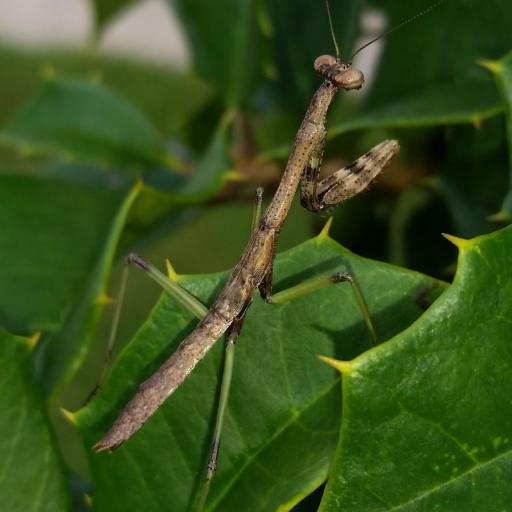
Known as the "Stealthy Sentinel" of North American gardens, the Carolina Mantis is a master of disguise and a favorite among backyard observers. Unlike its larger, introduced cousins, this native species is perfectly adapted to the meadows and forests of the United States. In folklore, their "praying" posture has led many to view them as spiritual guides or symbols of patience, but in reality, they are the ultimate ambush predators.
🔍 How to Identify
- ⚔️ Raptorial Forelegs: Equipped with sharp, interlocking spines, their front legs are designed to snap shut like a trap in a fraction of a second.
- 🎭 Cryptic Coloration: Their bodies vary from dusty brownish-gray to lime green, often mottled to look exactly like lichen or dead leaves.
- 🖤 The Wing Spot: A key identifying mark is a distinct dark or black spot located on the outer forewings (tegmina).
- 📐 Proportions: They are smaller and stouter than the invasive Chinese Mantis. Notably, a female’s wings usually only cover about three-quarters of her abdomen, leaving the end exposed.
🌲 Habitat & Ecology
- 🐝 The Garden Guardian: These are "A-list" garden friends. They consume a wide variety of pests including flies, moths, and small grasshoppers, acting as a natural chemical-free pesticide.
- 🍃 The Leaf Dance: When moving, they often rock back and forth. This isn't just a quirk; they are mimicking a leaf swaying in the breeze to hide their silhouette from both prey and hungry birds.
- 🥚 Winter Ootheca: Females lay their eggs in a frothy, straw-colored mass called an ootheca, which hardens into a protective "styrofoam" texture to survive the winter frost.
⚠️ Safety & Toxicity
- 🛡️ Non-Toxic: The Carolina Mantis is completely non-venomous and possesses no stingers.
- 🖐️ Handle with Care: While they are generally docile toward humans, they may deliver a tiny, harmless pinch if they feel squeezed. They are safe to have around curious children and pets, though their "alien" appearance might give a slight jump-scare!
✨ Fun Fact
The Carolina Mantis is a "color-shifter." While they can't change color instantly like a chameleon, an individual can actually adjust its color from green to brown during its molting phase to better match the specific environment it settled in for the season!
More Details








