Info
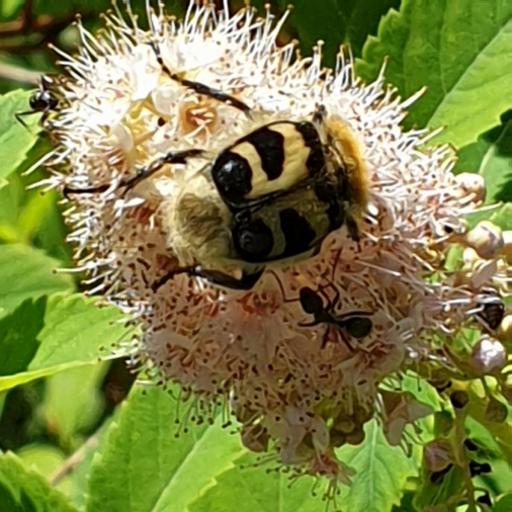
Often called the Bee Beetle, this charming insect is a master of disguise. It spends its summer days pretending to be a stinging bumblebee to scare off hungry birds, while in reality, it is a gentle, fuzzy pollen-eater. You’ll usually spot them sunbathing on large, flat wildflowers or "swimming" through petals in mid-summer.
🔍 How to Identify
- 🐝 The Mimicry: Dense, pale yellow or orange "fuzz" covers the thorax and underside, perfectly mimicking the hairy texture of a bumblebee.
- 🎨 Patterned Wings: The yellow wing cases (elytra) are marked with three distinct black bands. These patterns are unique to each individual, much like a human fingerprint.
- 🦵 Scarab Legs: Despite its bee-like appearance, it has the sturdy, spiny legs typical of the scarab beetle family, which it uses to grip tightly onto wind-blown flowers.
🌲 Habitat & Ecology
- 🌸 Pollen Parties: Adults are major fans of "Umbel" flowers (like Hogweed or Wild Carrot) and Wild Roses. They crawl over the flower heads to feast on protein-rich pollen and sweet nectar.
- 🪵 Woodland Nursery: While the adults love the sun, the larvae (grubs) live in the shadows. They spend up to two years developing inside decaying birch, oak, or beech wood, helping to break down dead timber into rich soil.
- 🌤️ Summer Resident: They are most active from June to August, particularly in woodland clearings, upland meadows, and gardens located near old forests.
⚠️ Safety & Toxicity
- ✅ Harmless Friend: The Bee Beetle is a "bluffer." It has no stinger, no venom, and its mandibles are too weak to bite humans or pets.
- 🛡️ Passive Defense: If it feels threatened, its primary defense is simply to fly away or drop into the undergrowth and hide. It is perfectly safe for children to observe and for pets to be around.
✨ Fun Fact
- ✨ Temperature Control: The Bee Beetle’s dense coat of hair isn't just for camouflage; it acts as an insulator. This allows the beetle to stay warm and remain active on cloudy days or early mornings when other beetles are too cold to move!
More Details








