Info
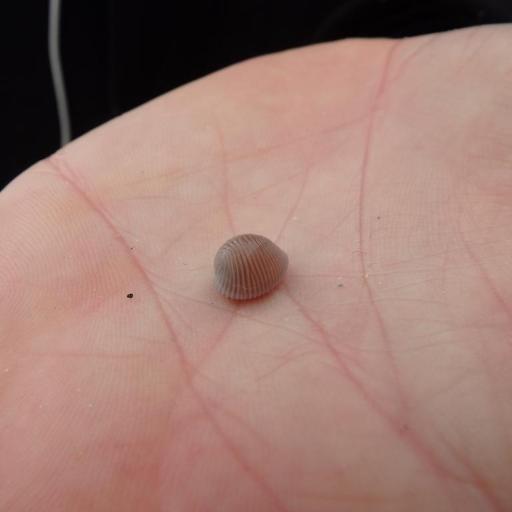
Often mistaken for a tiny "sea bug" or a polished pebble, the Northern Cowry (Trivia arctica) is one of the ocean's most beautiful miniature residents. Although its name and small, hard body might lead some to think of it as an insect, it is actually a specialized marine snail. Known to beachcombers as the "Coffee Bean" shell, this little creature is a hidden gem of the cold North Atlantic coastlines.
🔍 How to Identify
- 🐚 The Ribbed Shell: Its most striking feature is the series of fine, transverse ridges that run across the top of the shell, giving it a texture similar to a fingerprint or a tiny piece of corduroy.
- 🍑 Spotless Coloring: Unlike its close relative, the Spotted Cowry, Trivia arctica is uniform in color, ranging from a pale creamy white to a soft, fleshy pink or peach, with no dark spots on its back.
- 🧥 The Hidden Mantle: When underwater and undisturbed, the snail extends two fleshy lobes of its body (the mantle) to completely cover its shell. This behavior protects the shell and keeps it naturally polished and glossy.
🌊 Habitat & Ecology
- 🪨 Rocky Shoreline Resident: You won’t find these in the deep ocean; they prefer the intertidal zone. They spend their days tucked away in damp crevices, under large stones, or hidden within kelp forests to avoid drying out during low tide.
- 🍖 Specialized Hunter: Far from being a simple scavenger, this snail is a dedicated predator. It feeds almost exclusively on colonial sea squirts (tunicates), using a specialized ribbon of teeth called a radula to graze on its prey.
⚠️ Safety & Toxicity
- ✅ Harmless Friend: This species is completely safe for humans, children, and pets. It possesses no stingers, venom, or biting mouthparts, making it a favorite for curious tide-poolers.
- 🌊 Handle with Care: While it isn't toxic, the Northern Cowry is very sensitive to temperature and dehydration. If you pick one up to admire its shell, always return it to a cool, wet spot or a tide pool to ensure its survival.
✨ Fun Fact
In many ancient cultures, the shells of cowries were so highly prized for their beauty and portability that they were used as one of the world's first forms of international currency—literally acting as "the gold of the sea."
More Details








