Info
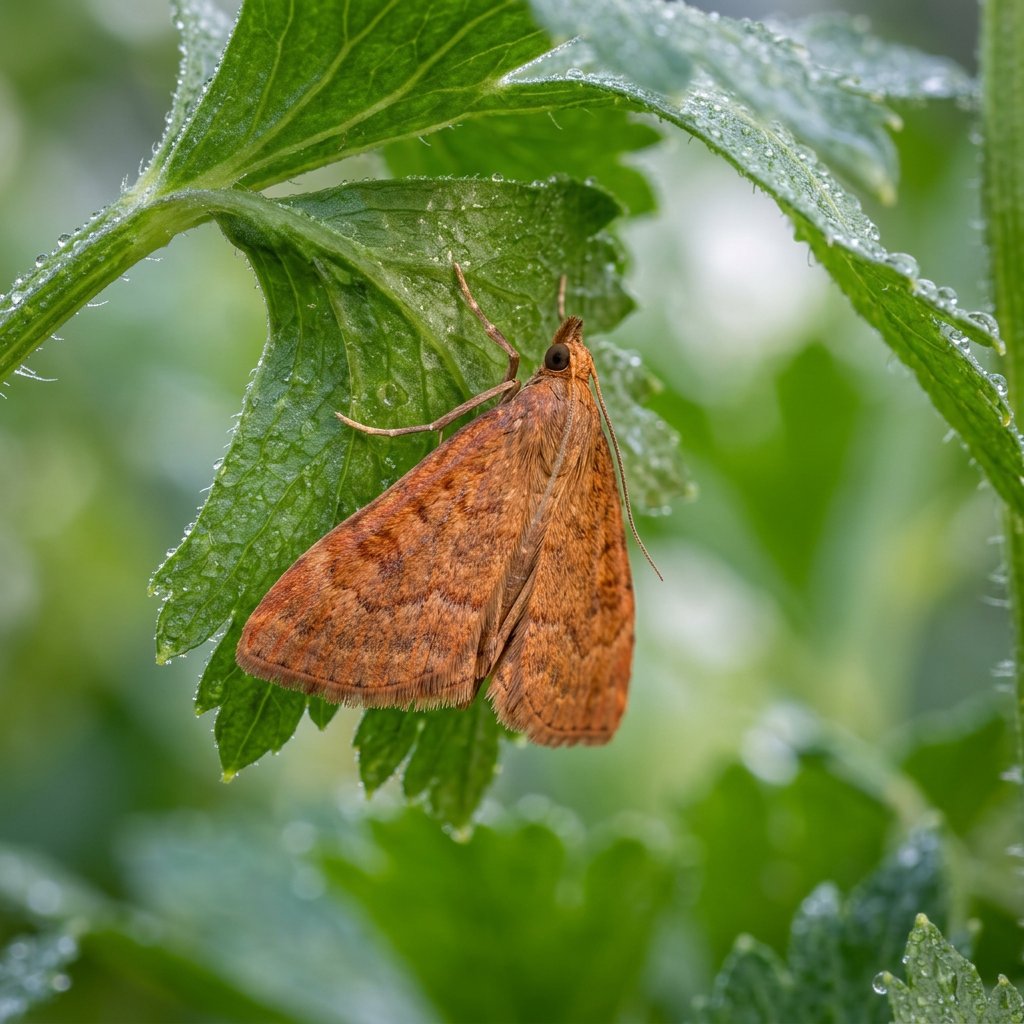
The Udea rubigalis, commonly known as the Celery Leaftier or Greenhouse Leaftier, is a master of disguise and a tiny architect of the garden world. While the adult moth is a subtle, clay-colored beauty, its larvae are famous (or perhaps infamous) for their clever "origami" skills—folding and tying leaves together with silk to create a private, leafy fortress. Found throughout North America, it is a frequent guest in both backyard vegetable patches and professional greenhouses.
🔍 How to Identify
- 🦋 Wing Color: The adult moth features forewings of a warm, pale brown or "ferruginous" (rust-like) hue, often dusted with darker scales.
- 〰️ Markings: Look for distinct dark, wavy lines zig-zagging across the wings and a small, dark, kidney-shaped spot known as a "reniform" mark.
- 📐 Resting Posture: When at rest, it holds its wings in a flat, triangular shape, perfectly mimicking a piece of dried leaf or debris.
🌲 Habitat & Ecology
- 🥬 Dietary Habits: As generalists, the larvae aren't picky eaters; they feast on everything from celery and lettuce to flowers like chrysanthemums and snapdragons.
- 🕸️ The "Leaftier" Method: The name comes from the caterpillar’s behavior of spinning fine silk threads to pull the edges of a leaf together, creating a hollow tube where it can hide from predators while it eats.
- 🌙 Nocturnal Activity: While the adults are mostly active at night, they are easily flushed out of tall grass or foliage during the day, flying in quick, jerky bursts before diving back into cover.
⚠️ Safety & Toxicity
- ✅ Harmless to Humans: The Celery Leaftier is completely non-toxic and does not bite or sting. It is safe to handle if you happen to find one.
- 🌱 Garden Impact: While safe for people and pets, they can be a nuisance for gardeners. Large populations can skeletonize leaves, though they rarely kill established plants.
✨ Fun Fact
The "leaftier" larvae are so sensitive to touch that if you disturb their silken home, they will often wiggle backward with surprising speed and drop to the ground on a "bungee cord" of silk to escape!
More Details








