Info
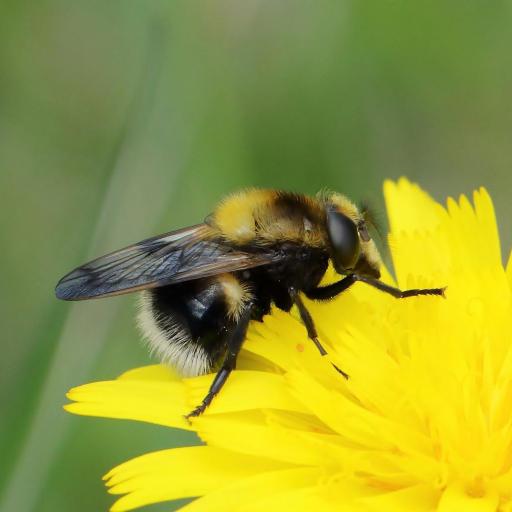
Known as the "Great Cuckoo Hoverfly," this master of disguise spends its life pretending to be something much more intimidating. By mimicking the thick, fuzzy bodies and color patterns of bumblebees, it gains a "free pass" from predators who want to avoid a nasty sting. Despite its convincing costume, this insect is a harmless fly and a dedicated garden pollinator.
🔍 How to Identify
- 🐝 The Great Mimicry: It looks remarkably like a bumblebee, with a round, hairy body. It usually appears in two forms: one with a red tail (mimicking the Red-tailed Bumblebee) and one with a white tail (mimicking the White-tailed Bumblebee).
- 🪶 Feathery Antennae: The easiest way to tell it’s not a bee is by looking at its antennae. It has a distinctive "plumose arista"—tiny, feathery hairs on the tips of its antennae that real bees lack.
- 👀 Fly Eyes: It has the massive, wraparound eyes typical of flies, rather than the more oval, side-set eyes of a bee. It also has only one pair of wings, whereas bees have two.
🌲 Habitat & Ecology
- 🕵️ The Undercover Guest: This fly earns the "Cuckoo" name because it sneaks into the underground nests of bumblebees to lay its eggs. It uses its bee-like appearance to slip past the sentries at the nest entrance.
- 🧹 A Helpful Scavenger: Once the larvae hatch inside the bee nest, they act as a "cleaning crew," eating debris and waste. However, they are opportunistic and may occasionally snack on the host's larvae if food is scarce.
- 🌸 Gentle Pollinator: As adults, you’ll find them hovering over brambles, thistles, and knapweed. They are agile fliers and spend their days drinking nectar and moving pollen from flower to flower.
⚠️ Safety & Toxicity
- ✅ Status: Completely Harmless: Despite its "scary" bee-like appearance, the Great Cuckoo Hoverfly does not have a stinger and cannot bite. It is a "friend" to gardeners.
- 🛡️ Bluffing Defense: If it feels threatened, it may buzz loudly or vibrate its wings to mimic the sound of an angry bee, but this is entirely a bluff to get you to move away.
✨ Fun Fact
Look closely at its face! The Volucella genus is famous for its "long face" or snout. Scientists believe the feathery hairs on its antennae help it "smell" the specific pheromones of the bumblebee nests it wants to infiltrate.
More Details








