Info
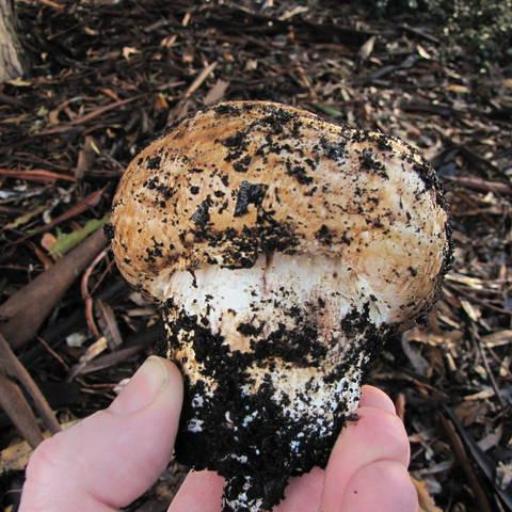
Known as the Giant Cypress Agaricus, this mushroom is a heavyweight of the fungal world. Often found hiding beneath the thick needle duff of coastal forests, it is famous for its massive size and the subtle, elegant lilac-to-bronze tint of its scaly cap. In the Pacific Northwest and California, stumbling upon a patch of these feels like discovering a cache of buried forest treasure.
🔍 How to Identify
- 🍄 The Cap: Massive and fleshy (up to 8 inches wide), covered in fine, pressed-down scales that range from pale lavender to a warm, brownish-purple.
- 🍫 The Gills: Deeply crowded and free from the stem; they start as a delicate pinkish-white in "buttons" before turning a rich, dark chocolate brown as they mature.
- 💍 The Stem & Ring: A thick, sturdy, white stalk featuring a prominent, skirt-like ring (annulus) that often has a "double-edged" appearance.
🌲 Habitat & Ecology
- 🌲 Cypress Companion: This species has a legendary association with Monterey Cypress and Eucalyptus trees, often growing in the nutrient-rich leaf litter or "duff" beneath them.
- 🍂 Urban Explorer: While it loves the forest, it isn’t shy about appearing in landscaped parks or older gardens where cypress trees have been established for decades.
⚠️ Safety & Toxicity
- 🛑 WARNING: While generally considered a "choice" edible by experienced foragers, never consume any wild mushroom without 100% certain identification.
- 🧪 The Look-alikes: It can be easily confused with the toxic Agaricus californicus or Agaricus xanthodermus (The Yellow Stainer). A key test is the scent: the edible Lilaceps smells pleasantly "mushroomy" or like anise, while toxic look-alikes often smell like chemicals, ink, or phenol.
- 🤢 Individual Sensitivity: Even edible Agaricus species can cause gastrointestinal distress in some people, and they are known to accumulate heavy metals from the soil in urban areas.
✨ Fun Fact
The "Lilac" in its name can be a bit of a tease! While young specimens have a distinct purplish hue, the color often fades to a dull brown as the mushroom expands and dries in the wind, making old specimens look like giant, weathered stones on the forest floor.
More Details
| Hymenium Type | Lamella |
| Stipe Character | Bare Stipe |
| Spore Print Color | Blackish-Brown |
| Mushroom Cap Shape | Flat Mushroom Cap |
| Hymenium Attachment | Free Hymenium Attachment |
| Mushroom Ecological Type | Mycorrhiza |