Info
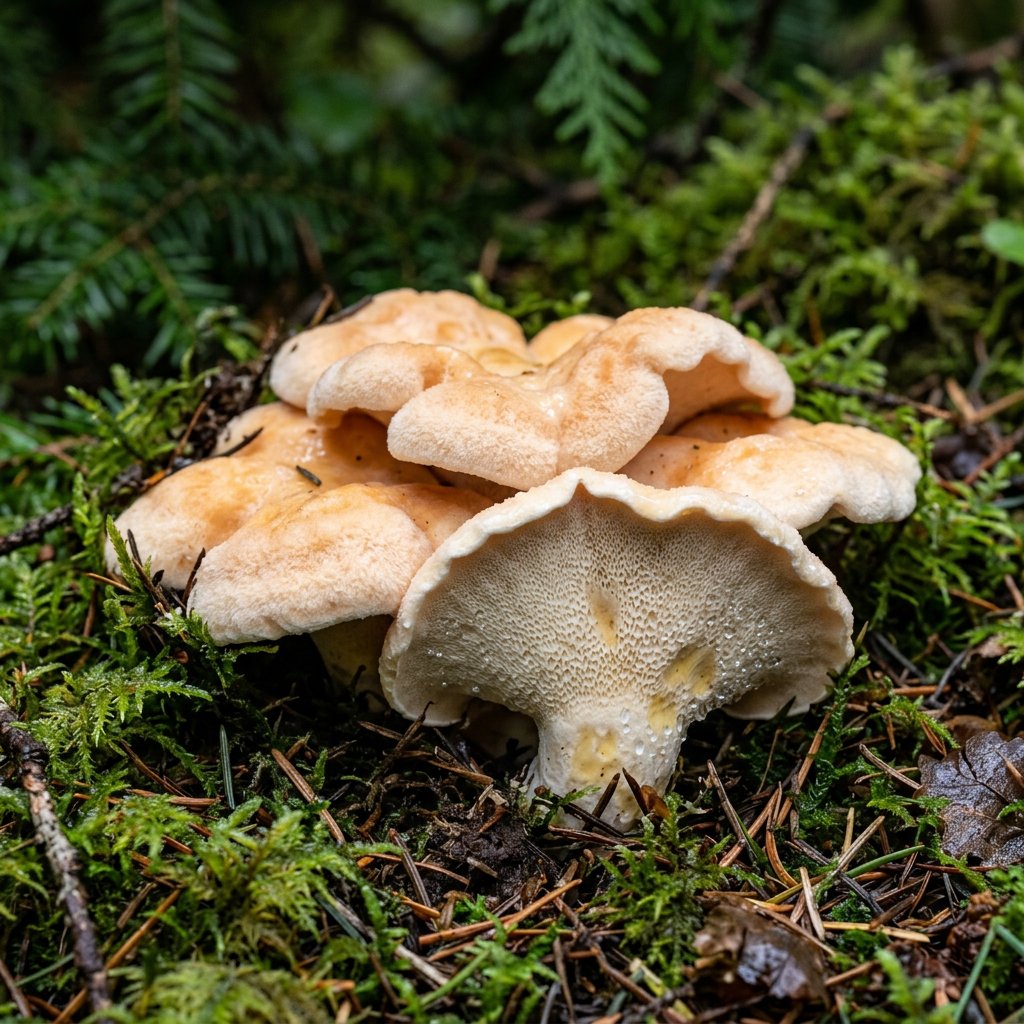
Commonly known as the Confluent Polypore, this mushroom is a master of the "group hug." Its name comes from its habit of growing so close together that several caps merge into one massive, undulating carpet of salmon and apricot hues. Often found decorating the floors of ancient coniferous forests, it looks more like a pile of toasted biscuits or spilled peach cobbler than a traditional toadstool.
🔍 How to Identify
- 🍄 The Cap: Fleshy and often irregularly shaped, ranging from 3 to 20 cm across. The color is distinctive: a soft peach, salmon-orange, or yellowish-tan that deepens as it matures.
- 🕳️ The Pores: Instead of gills, the underside features tiny, white-to-cream-colored pores that run slightly down the stem. These pores are very small and can be hard to see without a close look.
- 🪵 The Stem: Short, stout, and often off-center. Because the mushrooms grow in such tight clusters, the stems frequently fuse together at the base into a single, tough mass.
🌲 Habitat & Ecology
- 🌲 Conifer Companion: This fungus forms a vital symbiotic relationship with coniferous trees, particularly spruce and pine. It helps the trees absorb nutrients while receiving sugars in return.
- 🍂 The Hidden Network: While the "fused" caps are what we see, they are part of a massive underground mycelial network. It prefers acidic soils and is most commonly found in late summer and throughout the autumn in cool, temperate regions.
⚠️ Safety & Toxicity
- 🚨 WARNING: Albatrellus confluens is generally considered edible, but it is not highly prized. Many foragers find it to be quite bitter, especially as it ages, and it can become very "corky" and tough in texture.
- 🤢 Digestive Sensitivity: Even though it isn't toxic, it can cause mild stomach upset in some individuals. If you are a beginner, it is easily confused with other "terrestrial polypores," so expert confirmation is essential before consumption.
- 🐾 Pet Safety: While not known to be deadly, wild mushrooms should always be kept away from pets, as their digestive systems are much more sensitive to the complex fibers and compounds found in fungi.
✨ Fun Fact
When cooked, this mushroom does a bit of a magic trick—but not a very appetizing one! Its beautiful peach and salmon colors often shift into an unappealing dull green or yellowish-gray when heat is applied.
More Details