Info
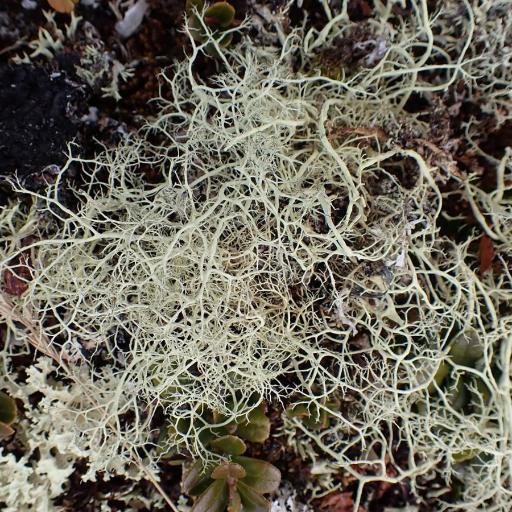
Often referred to as the Alpine Sulphur Lichen or "Tundra Witch’s Hair," Alectoria ochroleuca is a hardy survivor that looks more like a tangled bird's nest than a typical mushroom. It blankets the high-altitude landscapes of the world, thriving where most life retreats. In Nordic folklore, these wiry tufts were sometimes imagined as the discarded tresses of mountain spirits caught in the wind.
🔍 How to Identify
- 🟡 Sulphur Hue: The main body (thallus) is a distinctive pale yellowish-green or "ochre" color, which gives it a glowing appearance against dark soil or rocks.
- 🕸️ Wiry Structure: It grows in "fruticose" form, meaning it is shrubby and hair-like, forming stiff, tangled mats that feel somewhat brittle when dry.
- 🌑 Darkened Tips: A key identifying feature is the tips of the branches, which frequently transition into a dark brown or charcoal black.
🌲 Habitat & Ecology
- 🏔️ The Alpine Specialist: You won’t find this in your backyard unless you live near the arctic circle or atop a mountain peak. It prefers the "boreal-alpine" zone, growing directly on the ground (terricolous) in windswept tunra.
- 🌬️ Pollution Indicator: This lichen is an "obligate aerobe" that absorbs everything from the atmosphere. Because it lacks a root system, its presence is a gold-standard certificate for incredibly pure, unpolluted air.
- 🦌 Tundra Forage: While not a primary food source, it is often intermingled with "Reindeer Lichen" and is occasionally nibbled on by caribou and muskoxen during harsh winters.
⚠️ Safety & Toxicity
- 🚫 Status: Non-edible. While it doesn't contain the lethal amanitins found in some mushrooms, it is not a food source for humans.
- 🧪 Usnic Acid: It contains high concentrations of usnic acid. While this chemical has been studied for medicinal uses, ingesting the raw lichen can cause severe gastrointestinal distress and, in rare cases, has been linked to liver toxicity.
✨ Fun Fact
Alectoria ochroleuca produces its own "sunscreen"! The bright yellow usnic acid in its tissues acts as a chemical filter, protecting its delicate internal algae from the intense ultraviolet (UV) radiation found at high altitudes and polar latitudes.
More Details







