Info
Known as the "Eastern Destroying Angel," this mushroom is perhaps the most dangerous fungus in North America. Its ghostly, snow-white appearance looks pristine and innocent, but it hides a lethal secret. In various woodland myths, its pure white color was seen as a "shroud," a grim warning of its ability to end a life with just a single bite.
🔍 How to Identify
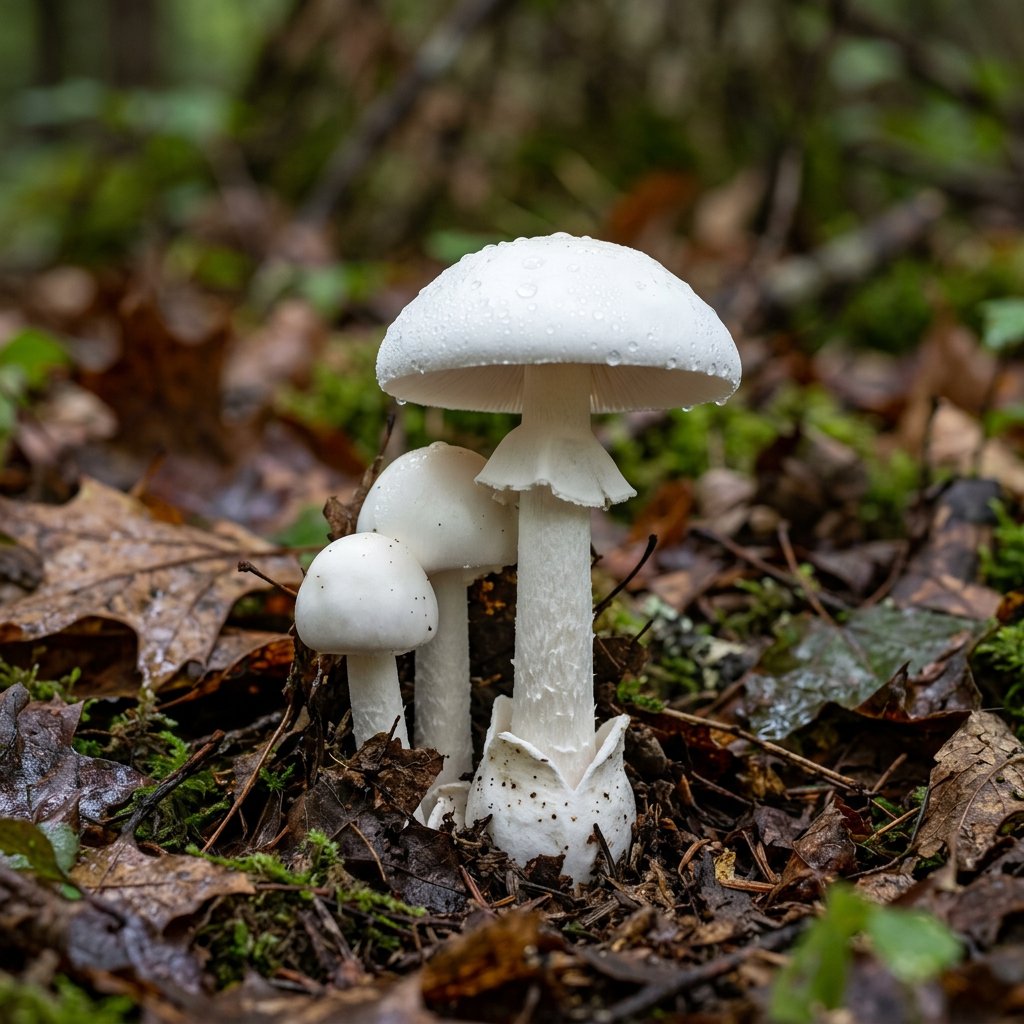
- 🍄 Pristine Cap: The cap is smooth, dry, and stark white. It begins as an oval "egg" shape before expanding into a flat, satiny disc.
- ❄️ White Gills: Unlike common grocery store mushrooms that turn brown, these gills remain stubbornly white throughout the mushroom's life and are not attached to the stem.
- 💍 Delicate Ring: A thin, skirt-like ring (annulus) circles the upper part of the stem, though it can sometimes be torn away by wind or rain.
- 🍶 The Volva: At the very base of the stem, often buried beneath the soil or leaf litter, sits a distinct, fleshy cup-like structure called a volva.
🌲 Habitat & Ecology
- 🌳 The Tree Partner: This mushroom is mycorrhizal, meaning it forms a complex underground partnership with trees. It is most commonly found near oaks, but it also frequents birch and beech forests.
- 🍂 Forest Floor Dweller: You will typically find it growing directly from the ground—never on logs or trees—appearing most frequently during the humid months of summer and autumn.
⚠️ Safety & Toxicity
- 🚨 DEADLY WARNING: This is one of the most toxic mushrooms in existence. It contains high concentrations of amatoxins, which cause permanent liver and kidney failure.
- 🚫 Deceptive Recovery: Ingestion is characterized by a "false recovery" period. After initial stomach distress, the victim may feel better for a day before the internal organs begin to shut down.
- 🧤 Safe to Touch: While it is safe to touch or look at, you must never taste it. Always wash your hands after handling any wild Amanita to ensure no spores or fragments are accidentally ingested.
✨ Fun Fact
The scientific name bisporigera actually describes a microscopic detail: while most mushrooms produce four spores on their reproductive cells, this "Angel" produces only two, a tiny detail that helps mycologists distinguish it from its equally deadly cousins.
More Details
| Hymenium Type | Lamella |
| Stipe Character | Ring And Volva Stipe |
| Spore Print Color | White |
| Mushroom Cap Shape | Convex Mushroom Cap |
| Hymenium Attachment | Free Hymenium Attachment |
| Mushroom Ecological Type | Mycorrhiza |