Info
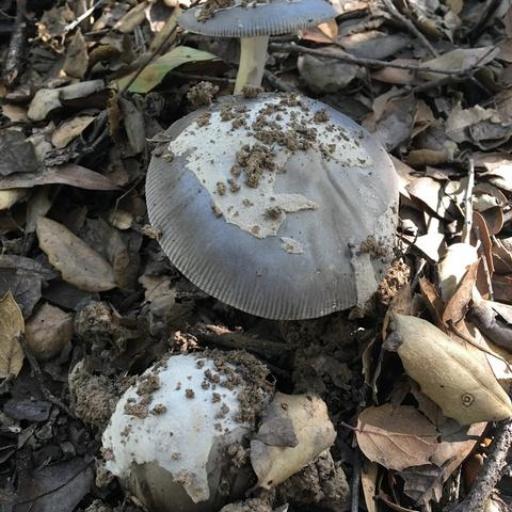
Commonly known as the Constricted Grisette, this elegant mushroom is a staple of the West Coast’s winter fungal landscape. Unlike its flashy, bright-red cousins, Amanita constricta prefers a more sophisticated palette of smoky grays and muted browns. It belongs to the "Grisette" group—a collection of Amanita species that lack the typical "skirt" or ring around the stem, giving them a sleek, minimalist silhouette.
🔍 How to Identify
- 🍄 The Cap: Usually 5–15 cm wide, the cap ranges from a pale mouse-gray to a deep brownish-gray. The most striking feature is the striate margin—deep, comb-like grooves running inward from the edge.
- ⚪ The Gills: The gills underneath are crowded and white, sitting "free" from the stem (meaning they don't quite touch it).
- 🦴 The Stem & Volva: The stem is hollow and lacks a ring (annulus). At the very base, it sits inside a thick, white, sack-like cup (the volva) that is notably constricted or tight against the stem, which gives the species its name.
🌲 Habitat & Ecology
- 🌳 The Oak Connection: This fungus is mycorrhizal, meaning it lives in a symbiotic "sugar-for-minerals" partnership with trees. In California and the Pacific Northwest, it is most frequently found lounging under Coast Live Oaks or nestled near Pacific Madrones.
- 🌧️ Winter Wanderer: While many mushrooms fruit in the fall, the Constricted Grisette is a fan of the rainy winter season, often appearing in large numbers after heavy West Coast storms.
⚠️ Safety & Toxicity
- 🚨 WARNING: While Amanita constricta is technically considered edible by some experienced foragers, it is NOT recommended for consumption.
- 🎭 Deadly Lookalikes: It belongs to a genus that contains the world’s most lethal mushrooms, including the Death Cap (Amanita phalloides). Beginners often mistake young, poisonous Amanitas for Grisettes before their identifying features (like the ring) fully develop.
- 🐕 Pet Safety: Like many wild fungi, it can cause severe gastrointestinal distress or worse if ingested by dogs or cats. Always keep curious paws away.
✨ Fun Fact
The term "Grisette" comes from the French word gris (gray). In 18th-century France, "grisette" referred to young working-class women who wore inexpensive gray fabric dresses—a fitting name for this humble, gray-clad mushroom of the forest floor!
More Details