Info
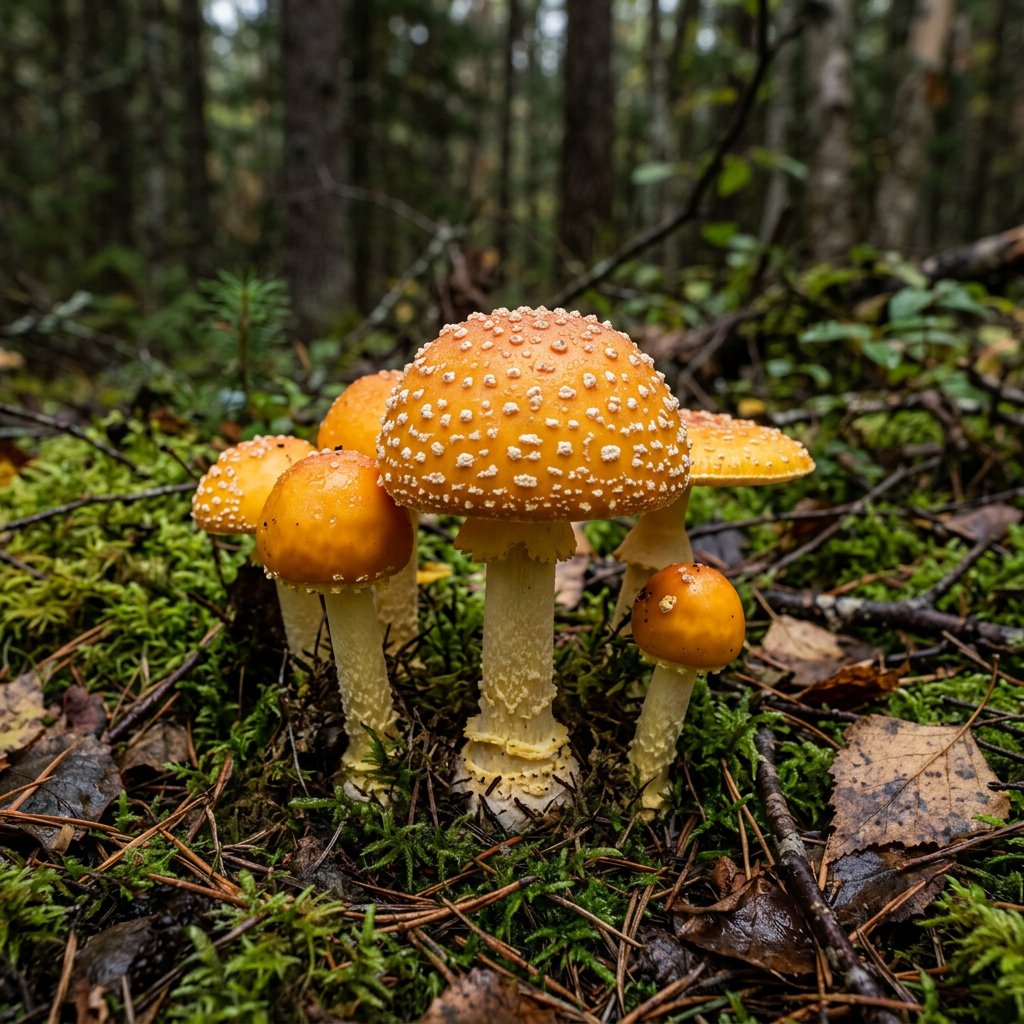
Often called "Frost’s Amanita," this cheerful little fungus looks like a sun-soaked, miniature version of the famous red-and-white Fly Agaric. While its brilliant yellow-to-orange hues might look like something out of a woodland fairytale, it is a sophisticated survivor found nestled in the leaf litter of North American forests. Despite its friendly appearance, it carries the complex chemical signature common to many members of the Amanita family.
🔍 How to Identify
- 🍄 The Cap: Small and convex, ranging from bright lemon-yellow to deep orange. It is usually speckled with tiny, pale yellow or white "warts" that can be washed away by heavy rain.
- 🍽️ The Gills: Close together and creamy white to pale yellow. They are "free" from the stem, meaning they don't actually touch the stalk when you look underneath.
- 🦯 The Stem & Base: A slender white stalk featuring a delicate, skirt-like ring. The most telling feature is the bulbous base, which often has a distinct "collar" or rim of yellow tissue.
🌲 Habitat & Ecology
- 🌳 Forest Partners: This mushroom is mycorrhizal, meaning it lives in a beautiful partnership with trees. It is most commonly found near Oaks and Pines, where it exchanges soil nutrients for tree sugars.
- 🍂 Seasonal Appearance: It prefers the humidity of mid-summer through early autumn. You will rarely find it in massive clusters; it prefers to pop up as a "lone ranger" or in small, scattered groups across the forest floor.
⚠️ Safety & Toxicity
- 🚨 STATUS: TOXIC. Amanita frostiana should never be consumed. It is often confused with the edible "Yellow Chanterelle" by beginners (due to the color) or the toxic Amanita flavoconia.
- 🤢 The Risk: It contains ibotenic acid and muscimol, compounds that affect the central nervous system. Ingestion can lead to intense nausea, dizziness, hallucinations, and muscle spasms. Keep a close eye on dogs, as the bright color can sometimes attract curious pets.
✨ Fun Fact
This mushroom was named in honor of Charles Christopher Frost, a 19th-century shoemaker from Vermont who had no formal education but became one of the most respected amateur mycologists in American history!
More Details







