Info
Known as the "Fly Agaric," the Amanita muscaria is perhaps the most iconic mushroom in the world. From the power-ups in Super Mario to the whimsical illustrations in Alice in Wonderland, its bright red cap and snowy white spots are synonymous with "magic" and "mystery." While it looks like it belongs in a fairytale, this fungus has a complex history involving ancient shamanic rituals and forest ecology.
🔍 How to Identify
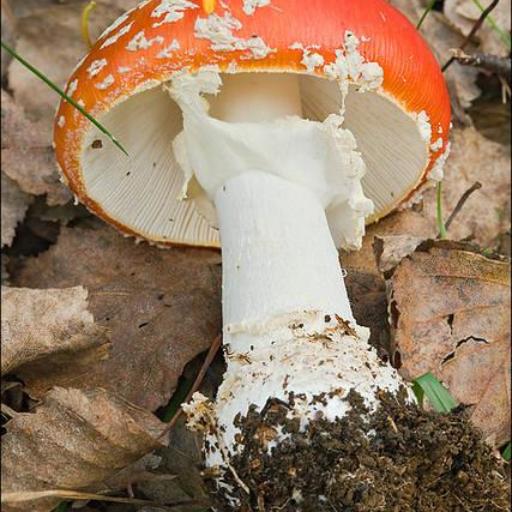
- 🔴 The Cap: A striking scarlet to deep orange dome (flattening with age) covered in white, wart-like spots which are actually remnants of its protective "veil."
- ⚪ The Gills: Located underneath the cap, the gills are crowded, pure white, and "free," meaning they do not attach directly to the central stem.
- 🧣 The Ring & Stem: A sturdy, white, hollow stem that features a floppy, skirt-like ring near the top and a bulbous base with shaggy ridges.
🌲 Habitat & Ecology
- 🤝 Tree Partners: This mushroom is "mycorrhizal," meaning it lives in a symbiotic "handshake" with the roots of trees like Birch, Pine, and Spruce, trading nutrients for sugars.
- 🍂 Seasonal Appearance: You are most likely to find them peeking through leaf litter or mossy forest floors from late summer through late autumn, often appearing in groups or "fairy rings."
⚠️ Safety & Toxicity
- 🚫 WARNING: The Fly Agaric is toxic and psychoactive. It is NOT a culinary mushroom and should never be consumed.
- 🧪 The Risk: It contains ibotenic acid and muscimol, which can cause severe nausea, muscle twitches, confusion, and intense hallucinations. While rarely fatal to healthy adults, it can be extremely dangerous for children and is highly toxic to dogs and cats.
✨ Fun Fact
- 🎅 The Original Santa: Some folklorists believe the legend of Santa Claus is linked to Siberian shamans who collected these mushrooms. They would dry them on the branches of pine trees (like ornaments) and then enter yurts through the smoke hole (the chimney) to distribute them during the winter solstice.
More Details
| Hymenium Type | Lamella |
| Stipe Character | Ring And Volva Stipe |
| Spore Print Color | White |
| Mushroom Cap Shape | Flat Mushroom Cap Or Convex Mushroom Cap |
| Hymenium Attachment | Free Hymenium Attachment |
| Mushroom Ecological Type | Mycorrhiza |