Info
Often called the "Death Angel" or the "Destroyer Angel" of the West, this mushroom possesses a haunting, ghostly beauty that hides its lethal nature. Found primarily in Western North America, it is a master of disguise, frequently appearing in oak woodlands during the damp spring months. Its pristine, white appearance has unfortunately led many foragers to mistake it for edible varieties, cementing its reputation as one of the most dangerous fungi in existence.
🔍 How to Identify
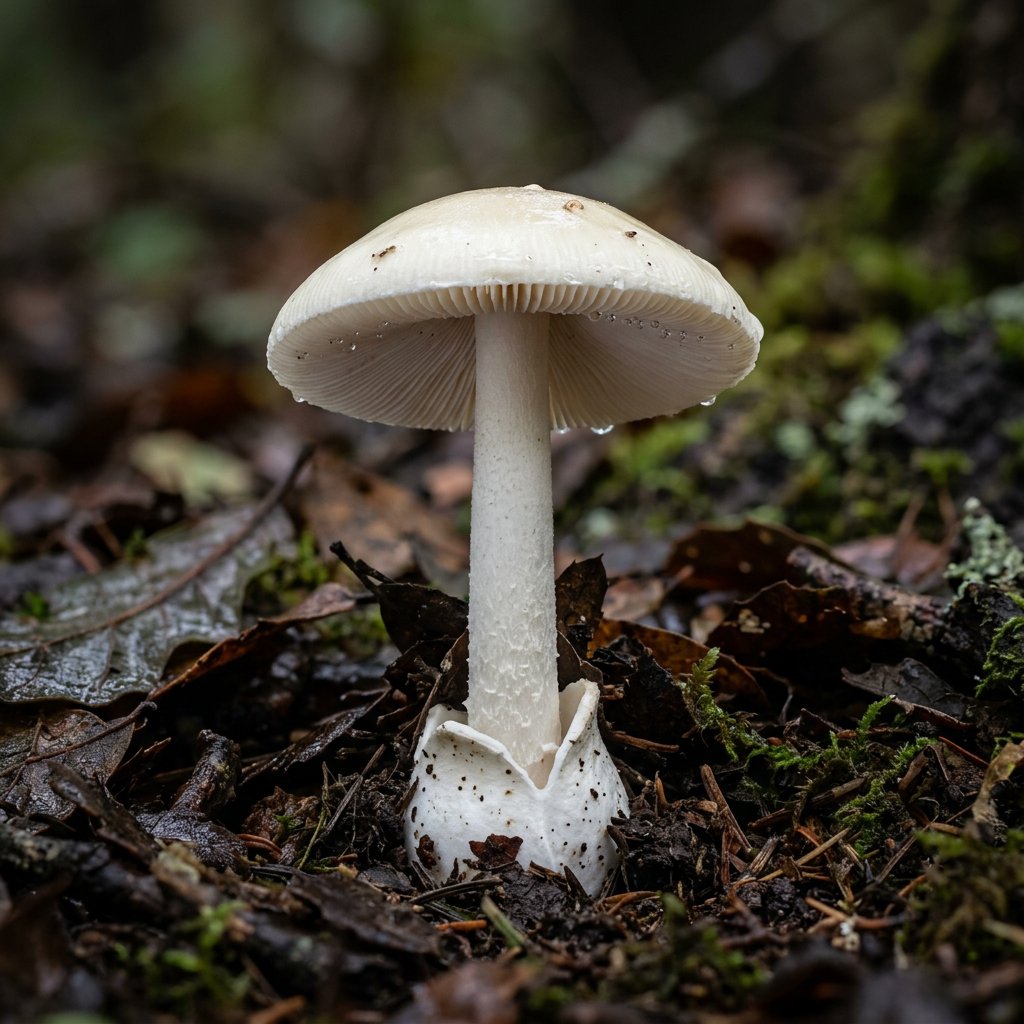
- 🍄 The Cap: Smooth, dry, and stark white to creamy. When young, it is hemispherical, eventually flattening out as it matures, sometimes developing a yellowish or buff tint in the center.
- ⚪ The Gills: The underside features crowded, white gills that are "free," meaning they do not attach directly to the stem.
- 💍 The Stem & Ring: A tall, slender white stem that features a thin, skirt-like ring (annulus) near the top, which can sometimes wither or tear away as the mushroom grows.
- 🥡 The Volva: At the very base of the stem, often buried beneath the soil, sits a prominent, white, sac-like cup called a volva—a crucial identifying feature of the Amanita family.
🌲 Habitat & Ecology
- 🌳 Oak Associations: This mushroom is mycorrhizal, meaning it lives in a symbiotic relationship with trees. It is most commonly found growing near Coast Live Oaks and other hardwood species in California and the Pacific Northwest.
- 🌧️ Spring Emergence: Unlike many other toxic Amanitas that appear in the fall, Amanita ocreata is a spring specialist, popping up following heavy winter rains between January and May.
⚠️ Safety & Toxicity
- 🚫 DEADLY WARNING: This is one of the most poisonous mushrooms in the world. It contains amatoxins, which are heat-stable (cooking does not make it safe) and cause irreversible damage to the liver and kidneys.
- 🚑 The Danger Zone: Ingestion is a medical emergency. There is often a "latent period" of 6 to 24 hours where the victim feels fine, followed by severe gastrointestinal distress and eventual organ failure.
- 🐾 Pet Safety: This mushroom is equally lethal to dogs and cats, who may be attracted to its scent in wooded backyards or on hiking trails.
✨ Fun Fact
The amatoxins in the Death Angel are incredibly efficient at their "job"; they specifically target an enzyme called RNA polymerase II, effectively "turning off" the ability of your cells to produce proteins, which leads to cellular death throughout the body.
More Details
| Hymenium Type | Lamella |
| Stipe Character | Ring And Volva Stipe |
| Spore Print Color | White |
| Mushroom Cap Shape | Convex Mushroom Cap |
| Hymenium Attachment | Free Hymenium Attachment |
| Mushroom Ecological Type | Mycorrhiza |







