Info
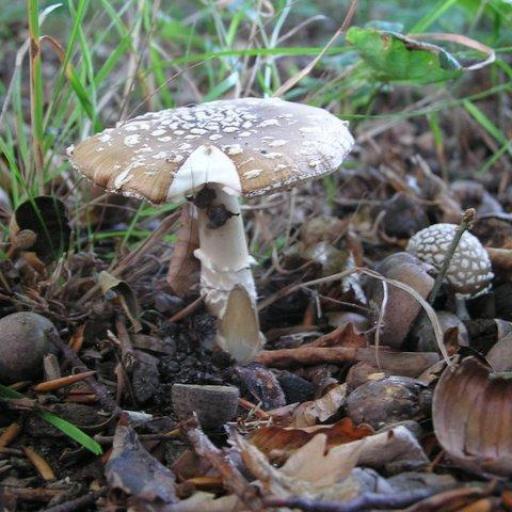
Often called the Panther Cap, this elegant but dangerous fungus is the moody, earth-toned cousin of the iconic red-and-white Fly Agaric. With its spotted brown cap and "camo" appearance, it looks like it belongs in a dark fairytale, lurking quietly near the roots of ancient trees. While its "panther" spots give it a wild beauty, it is one of the most potent and hazardous mushrooms a forager can encounter.
🔍 How to Identify
- 🍄 The Cap: Ranging from hazelnut brown to dark umber, the cap is typically 5–12 cm wide and covered in small, white, "cottony" warts—remnants of its protective veil that look like distinct polka dots.
- ⚪ The Gills: Underneath the cap, the gills are crowded and remain a crisp, pure white. They are "free," meaning they do not actually touch the stem.
- 💍 The Stem & Base: The white stem features a delicate, thin ring (skirt) and ends in a very distinctive bulbous base. This base usually has a "rimmed" collar or a "sock-like" volva that looks like a small cup.
🌲 Habitat & Ecology
- 🌳 Forest Partners: This mushroom is mycorrhizal, meaning it forms a symbiotic "handshake" with trees. It is most commonly found under Beech and Oak, but it occasionally partners with Pine and Fir.
- 🍂 Seasonality: It prefers the transitional weather of late summer and autumn, often poking through leaf litter in well-established woodlands throughout the Northern Hemisphere.
⚠️ Safety & Toxicity
- 🚫 WARNING: Highly Toxic and potentially Deadly. Under no circumstances should this mushroom be consumed. It is frequently mistaken by foragers for the edible "Blusher" mushroom, often with tragic results.
- 🧪 The Poison: It contains high concentrations of ibotenic acid and muscimol. These are powerful neurotoxins that attack the central nervous system rather than the digestive tract.
- 🐕 Risk Factors: Extremely dangerous to humans, dogs, and cats. Ingestion causes "Pantherina Syndrome," characterized by severe hallucinations, confusion, muscle spasms, and in some cases, a deep, coma-like sleep or respiratory failure.
✨ Fun Fact
The Panther Cap is significantly more potent than its famous red relative, the Fly Agaric. Historically, it was so effective at knocking out insects that it was crumbled into saucers of milk to serve as a natural—and permanent—household fly trap.
More Details
| Hymenium Type | Lamella |
| Stipe Character | Ring And Volva Stipe |
| Spore Print Color | White |
| Mushroom Cap Shape | Flat Mushroom Cap |
| Hymenium Attachment | Free Hymenium Attachment |
| Mushroom Ecological Type | Mycorrhiza |







