Info
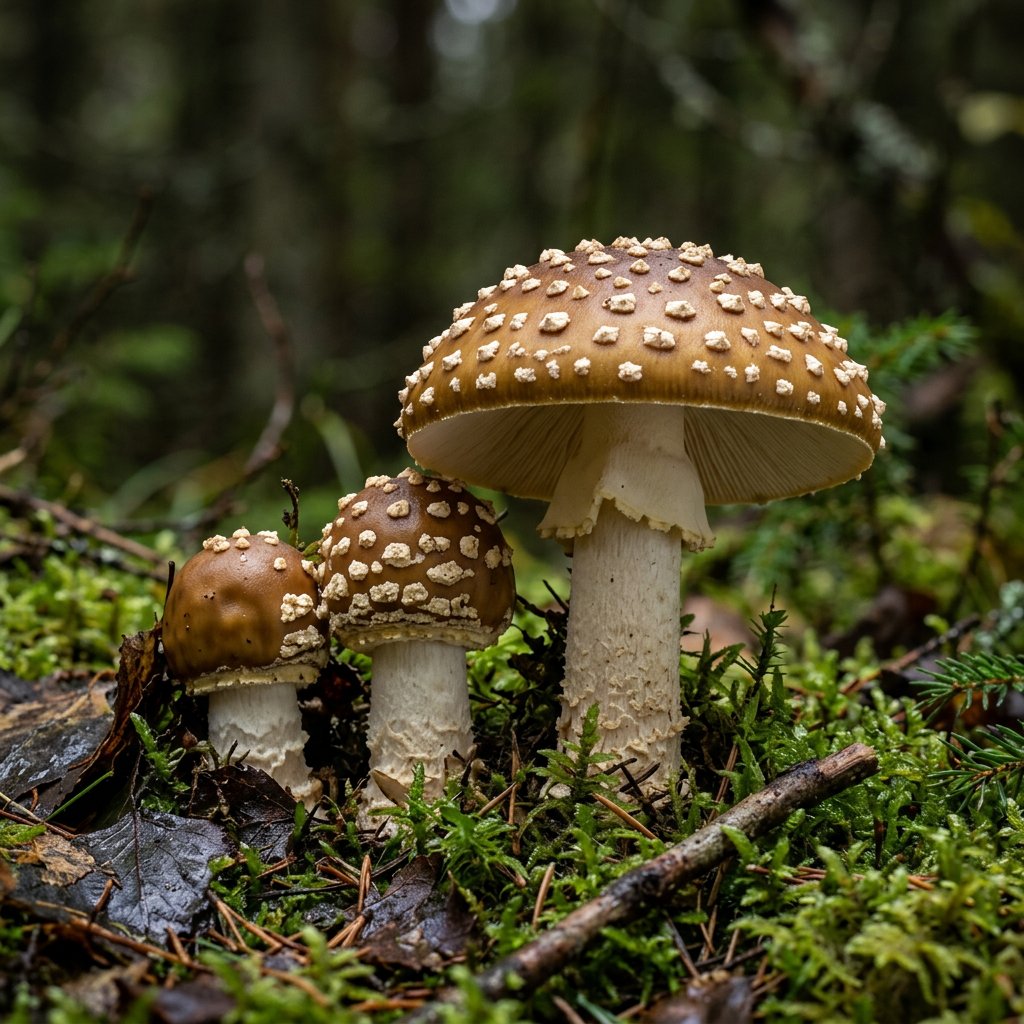
Known as the Royal Fly Agaric or the King of Sweden Amanita, this mushroom is the darker, more "regal" cousin of the famous red-and-white Toadstool. While it lacks the bright scarlet hue of its relatives, its stately chocolate-brown cap and golden-yellow patches make it a true standout in the damp woodlands of Northern Europe and Alaska. In many cultures, it is regarded as a symbol of the deep, old-growth forest, appearing like a crown emerging from the moss.
🔍 How to Identify
- 👑 The Cap: A large, sturdy dome (up to 20cm) that transitions from convex to flat. It is a distinctive liver-brown or "umber" color, decorated with yellow-to-tan warts or patches.
- ☁️ The Gills: Underneath, the gills are crowded and creamy white, never touching the stem (free gills).
- 💍 The Stem & Ring: The stalk is thick and white, featuring a soft, hanging ring (annulus). The base is bulbous and often has several "shaggy" rings of scales—the remains of its protective veil.
🌲 Habitat & Ecology
- 🌲 Tree Partners: This fungus is "mycorrhizal," meaning it lives in a symbiotic relationship with trees. It is most commonly found under Spruce and Pine, but occasionally nests near Birch trees.
- 🌍 Northern Resident: It thrives in cold, acidic soils and is a common sight in the Scandinavian wilderness and mountainous regions of Eastern Europe during late summer and autumn.
⚠️ Safety & Toxicity
- 🚫 WARNING: The Royal Fly Agaric is TOXIC. It contains ibotenic acid and muscimol, the same compounds found in the classic Fly Agaric, but often in higher concentrations.
- 🤢 The Risk: Ingestion causes severe gastrointestinal distress and "pantherina syndrome," which includes hallucinations, confusion, muscle twitches, and deep sleep. It is not considered edible and can be dangerous for pets and children if accidentally consumed.
✨ Fun Fact
Despite its name, the Amanita regalis was officially declared the "Mushroom of the Year" in Germany in 2000 to raise awareness about forest conservation and the beauty of fungal diversity beyond just the edible species!
More Details
| Hymenium Type | Lamella |
| Stipe Character | Ring And Volva Stipe |
| Spore Print Color | White |
| Mushroom Cap Shape | Convex Mushroom Cap |
| Hymenium Attachment | Free Hymenium Attachment |
| Mushroom Ecological Type | Mycorrhiza |