Info
Known as "The Blusher," Amanita rubescens is one of the forest's most intriguing shape-shifters. While many members of the Amanita family are infamous for their deadly toxins, the Blusher is unique for its "bruising" personality—literally turning a shy shade of pink or wine-red when handled or bitten by insects. In European folklore, it is often seen as a subtle inhabitant of ancient woodlands, hiding in plain sight among the leaf litter.
🔍 How to Identify
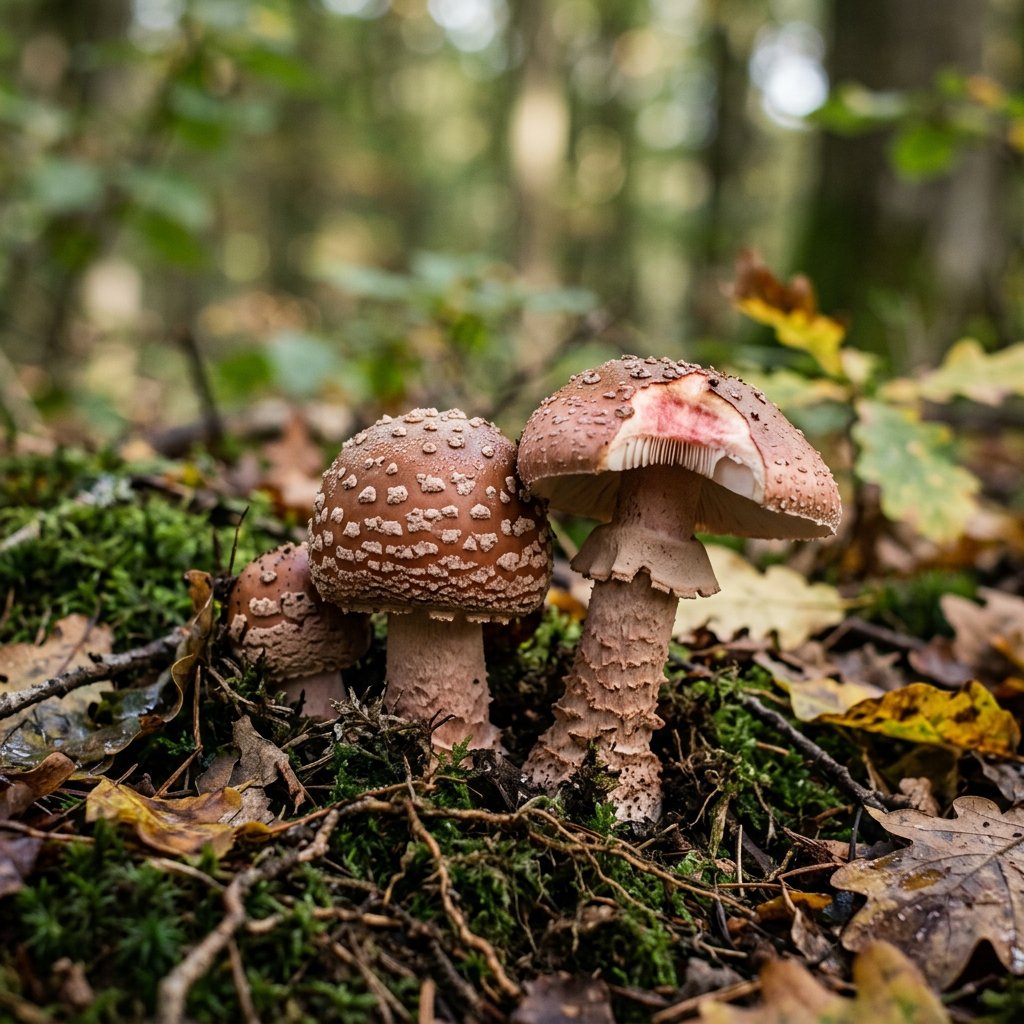
- 🍄 The Cap: Typically 5–15 cm wide, the cap ranges from pale brown to a reddish-pink hue. It is dotted with small, wart-like fragments of the "universal veil" that are usually grey or dirty white.
- 🍷 The "Blush": This is the most critical feature. If the flesh is cut, bruised, or damaged by maggots, it slowly stains a distinct pinkish-red or muddy rose color.
- 💍 The Stem & Ring: The stem is sturdy and features a large, white, skirt-like ring (annulus) near the top. The base is bulbous but lacks the distinct "cup" (volva) found in some of its deadlier relatives.
- ⚪ The Gills: The gills are white, crowded, and "free" (not attached to the stem). Like the rest of the mushroom, they may show red spots where damaged.
🌲 Habitat & Ecology
- 🌳 Tree Partners: This mushroom is mycorrhizal, meaning it lives in a symbiotic partnership with trees. It is commonly found near Oaks, Birches, and various pines, helping the trees absorb nutrients while taking a little sugar in return.
- 🌍 Widespread Resident: You can find the Blusher across Europe and North America from summer through autumn. It is a hardy species that can appear in both dense forests and even suburban parks if the right trees are present.
⚠️ Safety & Toxicity
- 🚨 WARNING: Never consume this mushroom unless you are an expert. While listed as edible in some regions, it contains hemolysins (toxins that destroy red blood cells) when raw. These toxins are destroyed by heat, but the risk of misidentification is extremely high.
- 🎭 The Deadly Double: The Blusher is frequently confused with the highly toxic Panther Cap (Amanita pantherina). The key difference is that the Panther Cap never blushes red when bruised and has a different stem base.
- 🐶 Pets: Keep dogs away, as raw ingestion can lead to severe gastrointestinal distress and blood-related complications.
✨ Fun Fact
The blushing reaction isn't just for show; it’s a chemical oxidation process. Because this mushroom is so frequently attacked by insects, the red staining is often the easiest way to find it—just look for the pink "tunnels" left behind by hungry mushroom fly larvae!
More Details