Info
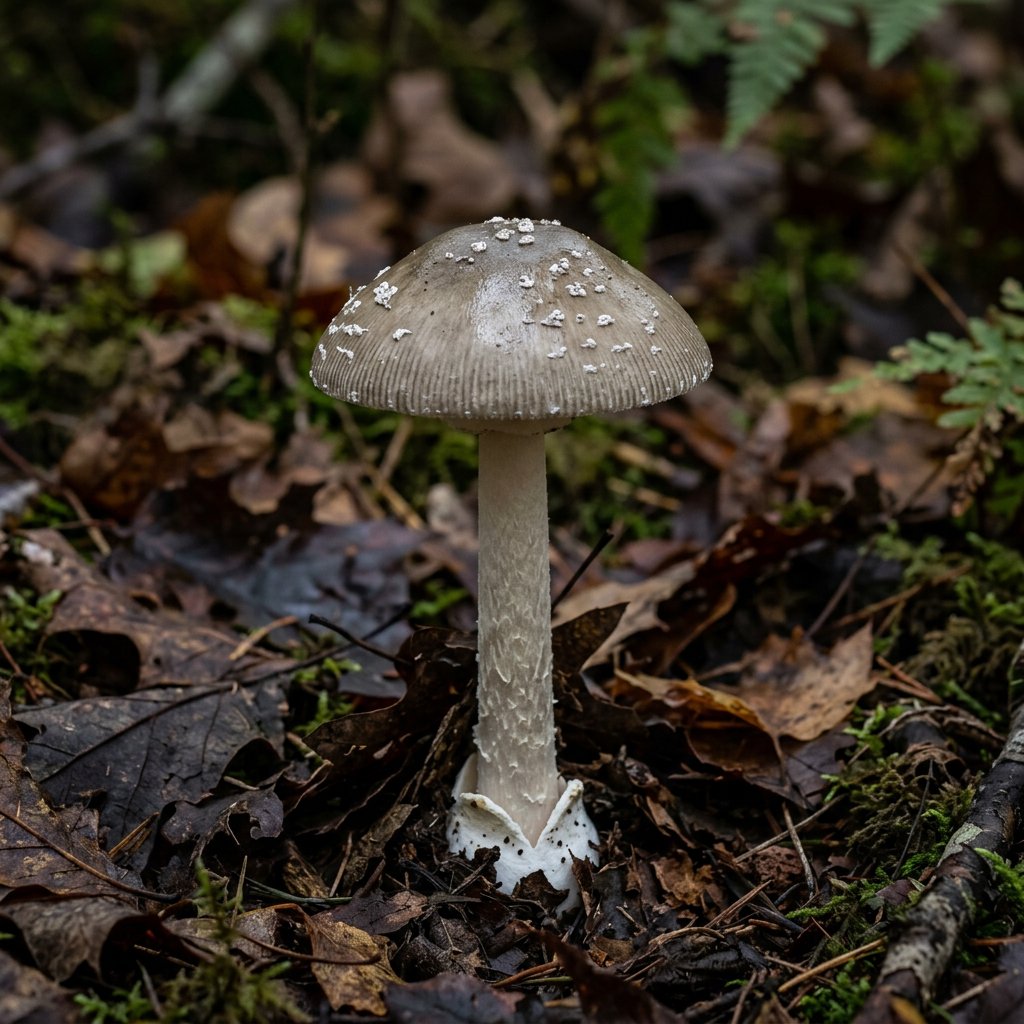
Known colloquially as the Hated Amanita, this slender and elegant mushroom belongs to one of the most notorious families in the fungal kingdom. Despite its somewhat dramatic name, its beauty lies in its muted, silvery tones and delicate structure. It is a common find in the woods of North America, often standing solitary like a ghostly sentinel among the fallen leaves.
🔍 How to Identify
- 🍄 The Cap: Usually 5 to 15 cm wide, the cap starts out convex and flattens with age. It features a distinct grayish-brown to silvery-tan color, often with a darker center and noticeably "combed" (striate) edges.
- ⚪ The Gills: The gills are crowded, white, and "free," meaning they do not actually touch the stem. If you look closely, you may see short gills (lamellulae) tucked between the full-length ones.
- 🦵 The Stem & Base: The stem is white and slightly tapered toward the top. It features a fragile, skirt-like ring and sits inside a white, sack-like "volva" at the base, which looks like the mushroom is wearing a loose-fitting boot.
🌲 Habitat & Ecology
- 🌳 Forest Partners: This mushroom is mycorrhizal, meaning it forms a symbiotic relationship with trees. It is most commonly found growing near Oak and Pine trees, helping the trees absorb nutrients while receiving sugars in return.
- 🍂 Leaf Litter Lover: You will typically find it popping up from late spring through autumn, usually in mixed hardwood forests or along the mossy edges of woodland paths.
⚠️ Safety & Toxicity
- 🚫 WARNING: Do not consume. While the "Hated Amanita" isn't as famously lethal as its cousin, the Death Cap, it is widely considered toxic. It is suspected to contain various amatoxins that can cause severe gastrointestinal distress or organ damage.
- 🐾 Pet Danger: Because it grows in common suburban wooded areas, it poses a significant risk to curious dogs. If you find this in your yard, it is best to remove it (using gloves) to protect pets and small children.
✨ Fun Fact
The name spreta comes from the Latin word for "scorned" or "despised." It earned this title from early mycologists, likely because it was frequently confused with other similar-looking species or simply considered less "noble" than the larger, more colorful Amanitas.
More Details