Info
Known as the Spring Amanita or simply Coccora, this stunning mushroom is a seasonal treasure for foragers in Western North America. Its warm, salmon-orange cap often peeks through the soil like a buried gem under oak trees. While it is celebrated as a choice edible by experts, it belongs to a family that contains some of the world's most lethal organisms, making it a mushroom that demands deep respect and careful study.
🔍 How to Identify
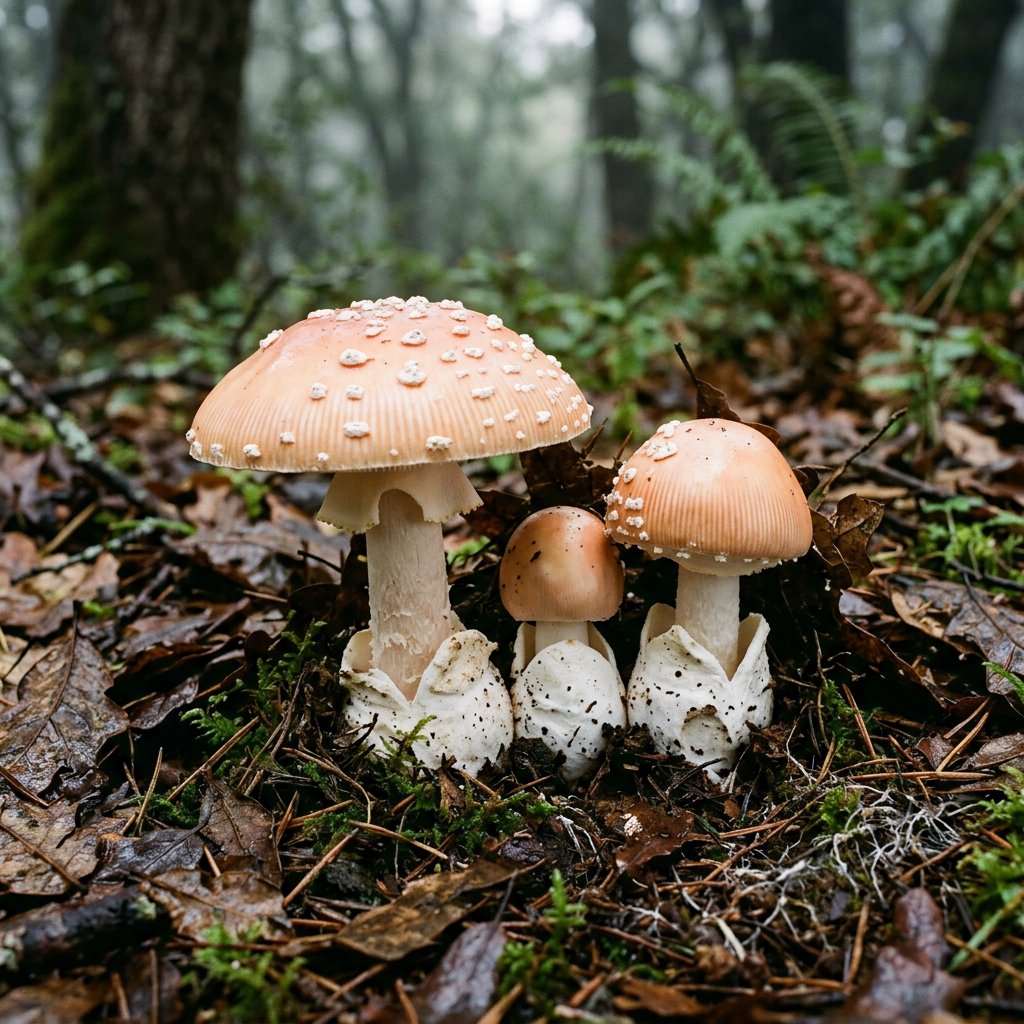
- 🍄 The Cap: Displays a beautiful shade of peach, apricot, or salmon-orange. It is typically smooth but almost always features a single, large, thick white patch (a remnant of its universal veil) sitting right in the center.
- 📏 The Margins: The edges of the cap have very distinct, deep grooves (striations) that look like the teeth of a comb. This is a key feature to distinguish it from some of its more dangerous relatives.
- ⚪ The Stem & Gills: The gills are crowded and white, while the stem is hollow and lacks a ring (annulus). At the very base of the stem, you will find a large, white, sac-like structure called a volva.
🌲 Habitat & Ecology
- 🌳 Oak Associations: The Spring Amanita is ectomycorrhizal, meaning it lives in a symbiotic partnership with trees. It is most commonly found under Coast Live Oaks and other hardwood species in California and the Pacific Northwest.
- 📅 The Spring Awakening: Unlike many mushrooms that fruit in the fall, Amanita velosa earns its name by appearing in late winter and spring. It often grows by pushing up heavy chunks of soil, creating little mounds known to foragers as "mushrumps."
⚠️ Safety & Toxicity
- 🚫 WARNING: While Amanita velosa itself is edible and delicious, it is NOT for beginners. It looks dangerously similar to the deadly Death Cap (Amanita phalloides) and the Destroying Angel (Amanita ocreata).
- 💀 The Risk: Mistakes in the Amanita family are often fatal. A faded or pale Coccora can easily be mistaken for a toxic species. Unless you are an expert who can confidently identify the volva, the lack of a ring, and the specific cap striations, this mushroom should never be consumed.
✨ Fun Fact
The species name velosa comes from the Latin word for "veiled" or "shaggy," referring to the prominent, felt-like white patch that almost always remains stuck to the top of its head, looking like a little white hat!
More Details
| Hymenium Type | Lamella |
| Stipe Character | Volva Stipe |
| Spore Print Color | White |
| Mushroom Cap Shape | Convex Mushroom Cap |
| Hymenium Attachment | Free Hymenium Attachment |
| Mushroom Ecological Type | Mycorrhiza |







