Info
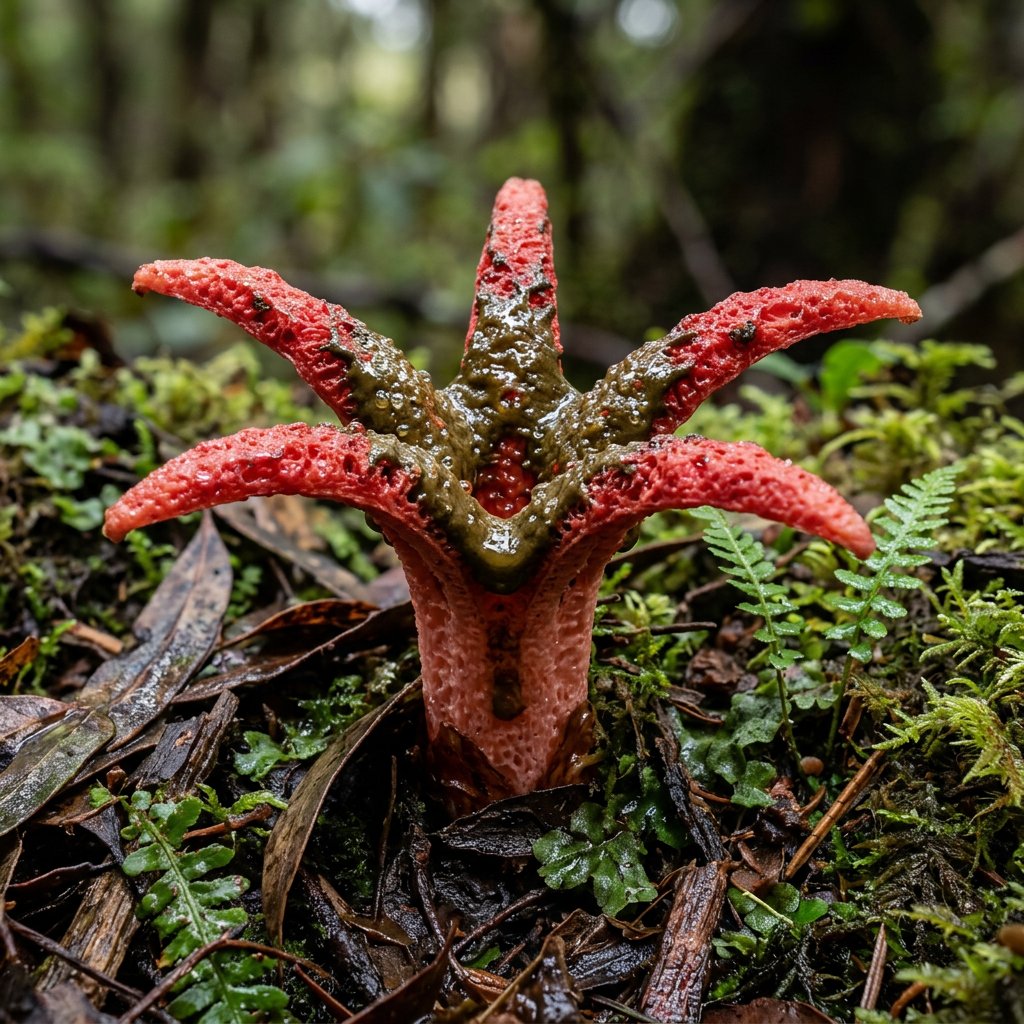
Often looking more like a stranded sea creature or a prop from a sci-fi film than a traditional mushroom, Aseroe rubra is famously known as the Starfish Fungus or Anemone Stinkhorn. Originally native to Australia and New Zealand, this bizarre organism has hitchhiked across the globe in garden mulch. It is legendary for its brilliant crimson color and a scent so foul it can be detected from several yards away.
🔍 How to Identify
- 🍄 The "Egg" Stage: Before it blooms, it emerges from the ground as a white, golf-ball-sized gelatinous "egg" that feels surprisingly heavy and firm.
- 🌟 The Star Arms: Once it erupts, it reveals a hollow white-to-pink stalk topped with a bright red disc. From this disc, 6 to 10 "arms" radiate outward, usually bifurcating (splitting in two) at the tips.
- 💩 The Slimy Center: The center of the star is coated in a thick, brownish-olive slime called "gleba." This is the spore-bearing mass that emits a pungent odor of rotting meat or sewage.
🌲 Habitat & Ecology
- 🍂 Garden Mulch Enthusiast: While it naturally occurs in alpine grasslands and forests, it has become a common "urban mushroom." It loves the nutrient-rich environment of wood chips and garden mulch used in suburban landscaping.
- 🪰 The Fly Connection: The fungus uses its offensive smell to trick flies and beetles into thinking it is a decaying carcass. When insects land on the slimy center, the spores stick to their legs and bodies, allowing the mushroom to "hitchhike" to new locations.
⚠️ Safety & Toxicity
- 🚫 WARNING: Aseroe rubra is strictly classified as inedible.
- 🤢 Potential Reaction: While not considered "deadly" in the way some Amanitas are, consuming it will lead to severe gastrointestinal distress, nausea, and vomiting. Its scent is usually so revolting that ingestion by humans or pets is extremely rare, but curious dogs should be kept away.
✨ Fun Fact
🚢 An Early Discovery: This was the first fungus from Australia to be scientifically described by Europeans. It was collected in Tasmania in 1792 by the French naturalist Jacques Labillardière, who was searching for the lost expedition of the explorer La Pérouse.
More Details







