Info
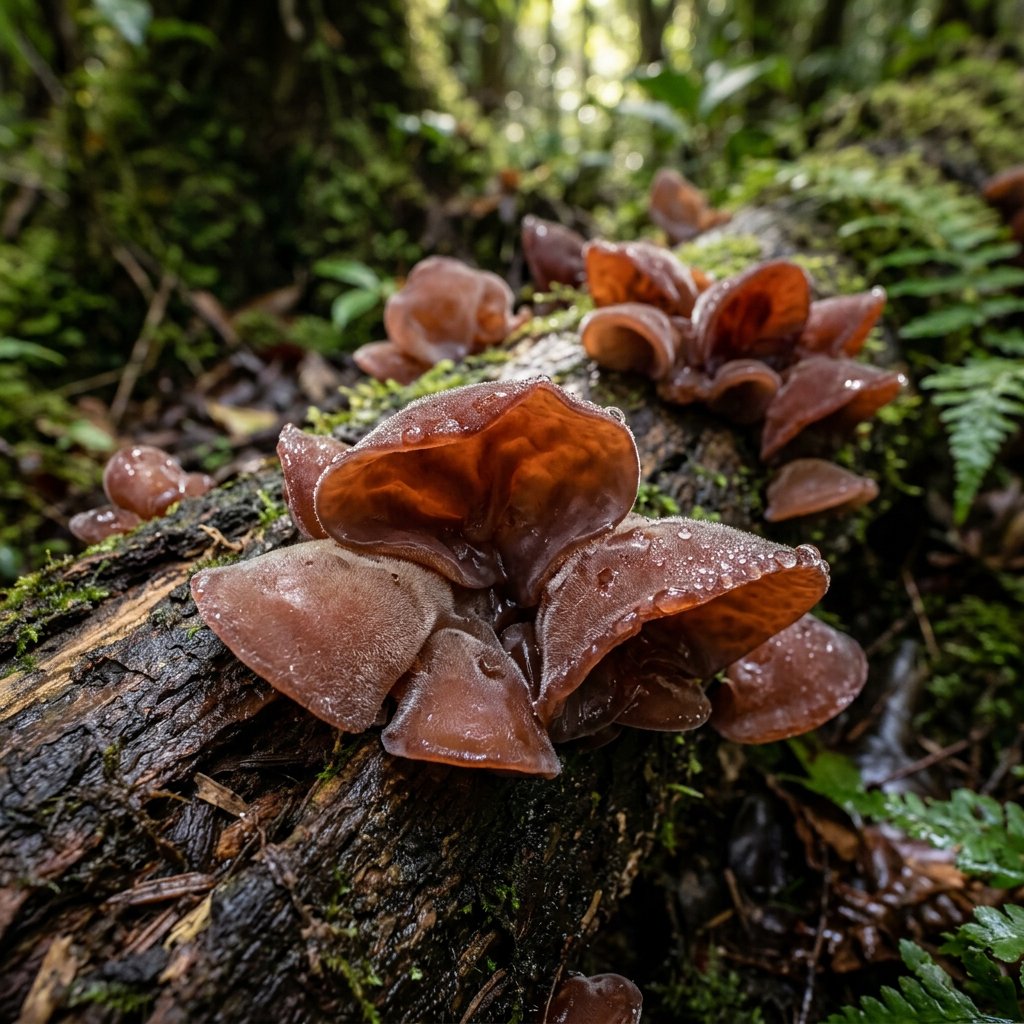
Often called the Amber Jelly Ear, this mushroom looks like a piece of translucent sea glass or a soft, rubbery ear growing out of a log. In many cultures, these "wood ears" are prized for their unique texture rather than their flavor, starring in soups where they soak up the essence of the broth. They are the forest’s masters of camouflage, shrinking into crusty black streaks when dry and "resurrecting" into their jelly-like form with the first drop of rain.
🔍 How to Identify
- 👂 The Shape: Typically irregular, cup-shaped, or resembling a human ear. It often grows in clusters, appearing wavy or lobed.
- 🍯 Color & Texture: Translucent amber, yellowish-brown, or reddish-purple. When moist, it is flexible and feels like firm jelly or soft rubber.
- 🕸️ Surface Detail: The "top" surface is usually smooth or covered in microscopic, velvety hairs, while the underside may feature shallow, vein-like ridges.
🌲 Habitat & Ecology
- 🌳 Woodland Recycler: This fungus is a saprobe, meaning it feeds on dead organic matter. You will find it almost exclusively on decaying hardwood logs and fallen branches in humid, tropical, or subtropical regions.
- 💧 The Resurrection Trick: Unlike many mushrooms that rot away, this species can completely dehydrate during a drought, turning into a hard, black crust. As soon as it rains, it rehydrates and continues releasing spores.
⚠️ Safety & Toxicity
- 🚨 WARNING: Never consume any wild mushroom unless you have confirmed the identification with a local expert. While Auricularia fuscosuccinea is widely considered edible and is a close relative of the culinary Wood Ear, it can be easily confused with other jelly-like fungi.
- 🍳 Preparation: If foraged safely, it must be thoroughly cleaned of grit and wood debris and should always be cooked. Raw mushrooms contain chitin, which is difficult for humans to digest and can cause stomach upset.
✨ Fun Fact
✨ The Culinary Sponge: This mushroom has almost no flavor of its own! It is used in traditional Asian cuisine specifically for its "crunchy-jelly" mouthfeel (often called q-texture). It acts like a culinary sponge, absorbing the spices and umami of the broths it is simmered in.
More Details