Info
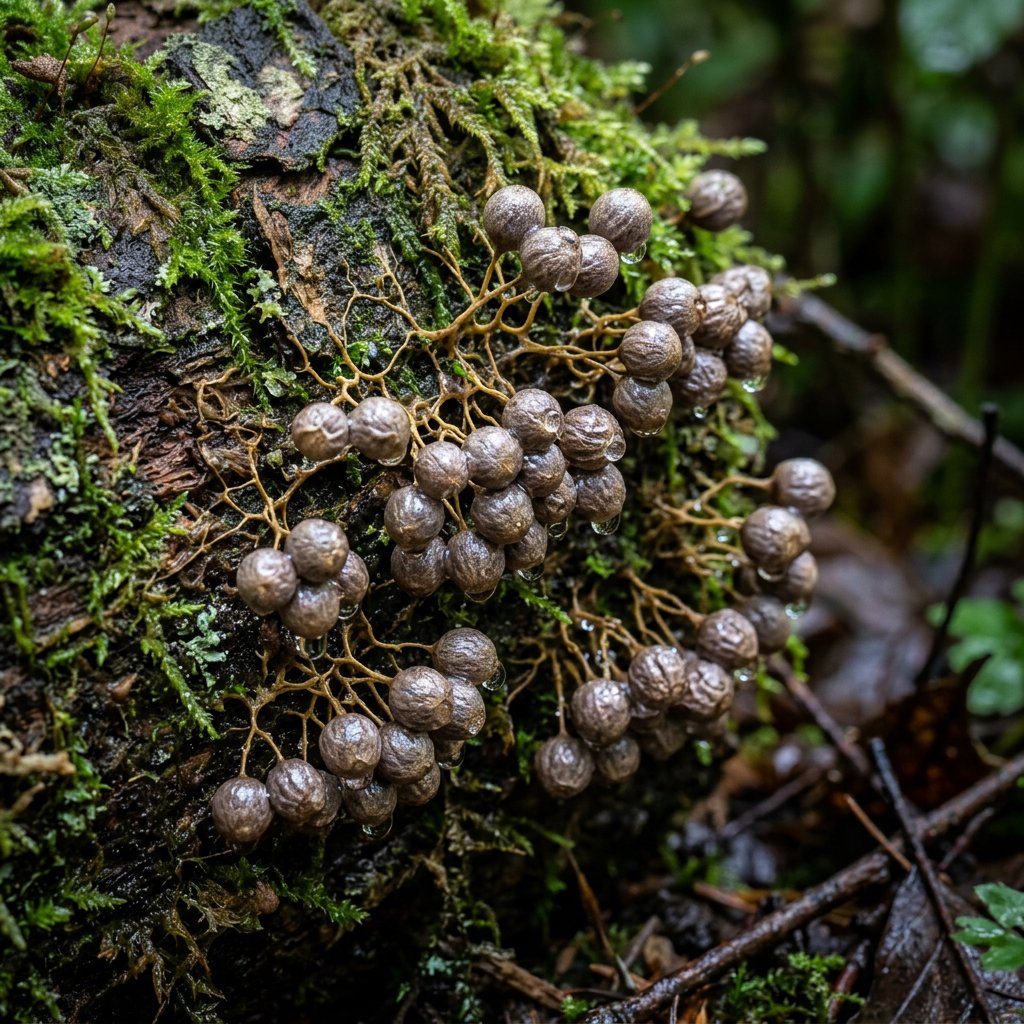
Often called the Grape Slime Mold, Badhamia utricularis is a fascinating "shape-shifter" of the forest floor. While it looks like a cluster of tiny, iridescent fruit, it isn't actually a mushroom at all—it is a Myxomycete, or slime mold. This primitive yet "intelligent" organism spends part of its life as a creeping mass of protoplasm, literally hunting for its favorite meal: woody bracket fungi.
🔍 How to Identify
- 🍇 Cluster Formation: It is most easily recognized by its small, pear-shaped or egg-shaped capsules (sporangia) that hang in dense, dangling clusters like miniature bunches of grapes.
- 💿 Iridescent Sheen: The surface of these "grapes" often has a beautiful metallic or silvery luster, appearing blue-gray or leaden-violet when mature.
- 🧵 Thread-like Stalks: The clusters are suspended by thin, weak, straw-colored stalks that look like tangled yellow silk or fine hairs.
🌲 Habitat & Ecology
- 🍄 The Fungal Hunter: Unlike many slime molds that feed on bacteria, Badhamia utricularis is a specialist predator. It actively crawls over logs to find and consume wood-rotting fungi, particularly Stereum (crust fungi).
- 🪵 Log Lifter: You will most likely find it on the underside of fallen hardwood logs in damp, shaded woodlands, especially during the cool, wet months of autumn and winter.
⚠️ Safety & Toxicity
- ⚠️ WARNING: While Badhamia utricularis is not considered poisonous, it is not edible. Slime molds have a dusty, spore-filled interior when mature and offer no nutritional value to humans.
- 🐾 Pet & Child Safety: It is generally considered harmless to touch. However, because it thrives in very damp environments, its presence may indicate the nearby growth of truly toxic fungi or molds that should be avoided.
✨ Fun Fact
Slime molds like Badhamia are "brainless" geniuses! Despite having no nervous system, they can solve mazes and find the most efficient path between food sources. Researchers have even used slime mold growth patterns to model the most efficient layouts for city subway systems.
More Details







