Info
Often known as the Ash-tree Bolete, this mushroom is an ecological enigma that tells a story of hidden underground alliances. While most boletes form direct partnerships with tree roots, this fungus plays a complex game of "three's company" involving Ash trees and tiny, woolly aphids. It is a common sight in eastern North America, often appearing in clusters after heavy summer rains, peeking out from under a blanket of fallen leaves.
🔍 How to Identify
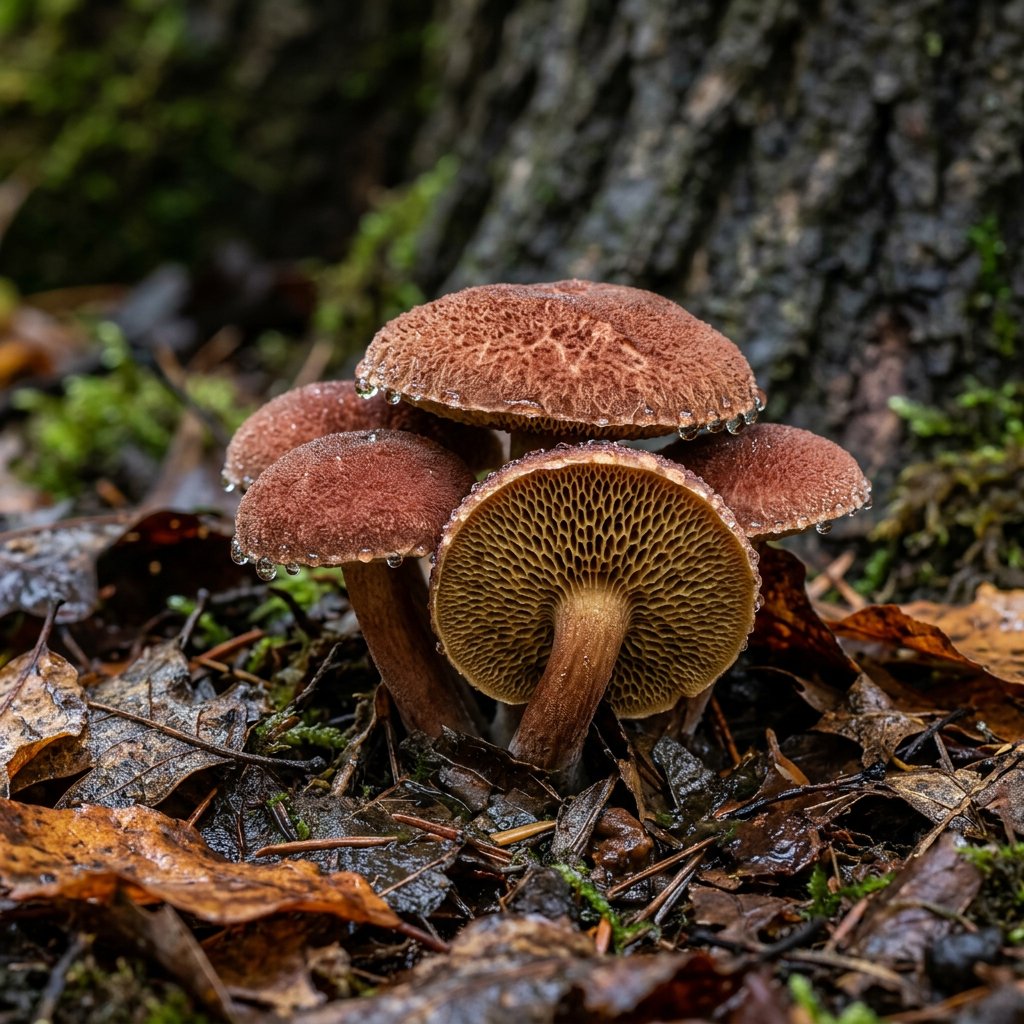
- 🍄 The Cap: Typically broad (5–15 cm), featuring a dull brown to reddish-yellow color. The shape is often irregular, kidney-shaped, or wavy, feeling slightly leathery or dry to the touch.
- 🕸️ The Pores: Unlike the "pin-hole" pores of typical boletes, these are large, angular, and look like a golden-yellow honeycomb. They are "decurrent," meaning they run slightly down the stem.
- 🦵 The Stem: The stalk is notably short and often "eccentric," meaning it attaches to the side of the cap rather than the center. It usually tapers toward the base and shares the same color as the cap.
🌲 Habitat & Ecology
- 🌳 The Ash Connection: This mushroom is almost exclusively found growing near Ash trees (Fraxinus spp.). If there isn't an Ash tree nearby, you are likely looking at a different species.
- 🐜 The Aphid Alliance: This fungus creates "sclerotia"—hard, underground nuggets—that protect and house the leaf-curl ash aphid. The fungus feeds on the sugary honeydew produced by the aphids, while the aphids get a safe home. It’s a rare example of a mushroom-insect-tree "love triangle."
⚠️ Safety & Toxicity
- 🚨 WARNING: Edible, but not recommended for beginners. While not considered poisonous, it is frequently confused with other boletes that can cause severe gastrointestinal distress.
- 👅 Palatability: Most foragers describe the flavor as mediocre, often tasting slightly acidic or "muddy." Because it grows close to the ground, it is also prone to being infested by maggots and grit.
- 🐕 Pets: Keep curious dogs away; while not "deadly," consuming wild mushrooms can lead to vomiting and diarrhea in pets.
✨ Fun Fact
The Boletinellus merulioides is a biological "freelancer." For years, scientists thought it was a parasite or a simple partner to the Ash tree, only to discover it was actually "farming" aphids underground to get its nutrients!
More Details