Info
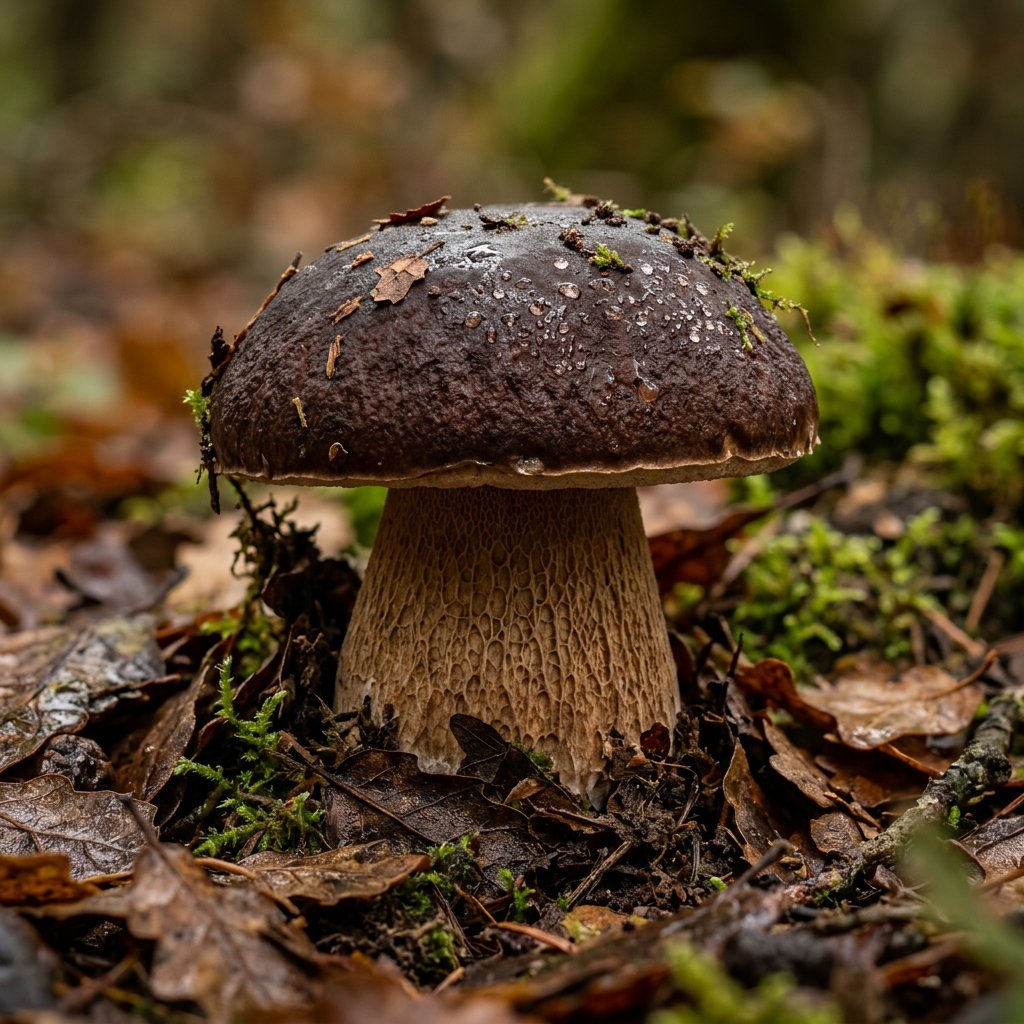
Often hailed as the "King of Kings" by mushroom hunters, the Bronze Bolete is the dark, handsome cousin of the famous Porcini. Known for its deep, chocolate-colored cap and incredibly firm texture, this mushroom is a legendary find in Southern European forests. In Italy, it is celebrated as the Porcino Nero, a delicacy that commands high prices and even higher respect in the kitchen.
🔍 How to Identify
- 🟤 The Cap: It features a striking, dark brown to almost blackish cap, often with "bronze" or copper-toned patches. The surface is dry and feels like fine suede or velvet when young.
- ⚪ The Pores: Unlike many mushrooms, it has no gills. Instead, it has a dense layer of tiny white pores that slowly turn soft yellow or olive-green as the mushroom matures.
- 🪵 The Stem: The stalk is thick, bulbous, and "fat," usually a lighter cinnamon or pale brown color. If you look closely, you’ll see a very fine, net-like pattern (reticulation) covering the upper part of the stem.
- 切 The Flesh: When sliced, the internal flesh is stark white and remains white—it does not turn blue, pink, or black when exposed to air.
🌲 Habitat & Ecology
- 🌳 Oak & Beech Friendships: This mushroom is mycorrhizal, meaning it lives in a symbiotic "handshake" with tree roots. It specifically prefers old-growth Oak, Beech, and Chestnut forests in warmer climates.
- ☀️ The Summer King: While many boletes wait for the cool autumn rains, the Bronze Bolete loves the warmth. It often pops up in late summer or early autumn after a heavy thunderstorm.
⚠️ Safety & Toxicity
- 🚨 WARNING: Always be 100% certain of your identification before considering any wild mushroom for consumption. Never eat a mushroom based on a photo alone.
- ✅ Status: Boletus aereus is a world-class, choice edible mushroom. It is safe for humans when properly identified and cooked.
- 👅 The Bitter Look-alike: It can be confused with the Bitter Bolete (Tylopilus felleus). While not poisonous, the Bitter Bolete tastes like intense bile and will ruin an entire meal. Check for pinkish pores and a dark, heavy net pattern on the stem to tell the "imposter" apart.
✨ Fun Fact
In the culinary world, the Bronze Bolete is often considered superior to the standard Porcini (Boletus edulis) because its flesh is much denser and holds its shape perfectly during cooking, rather than becoming soft or "slimy."
More Details







