Info
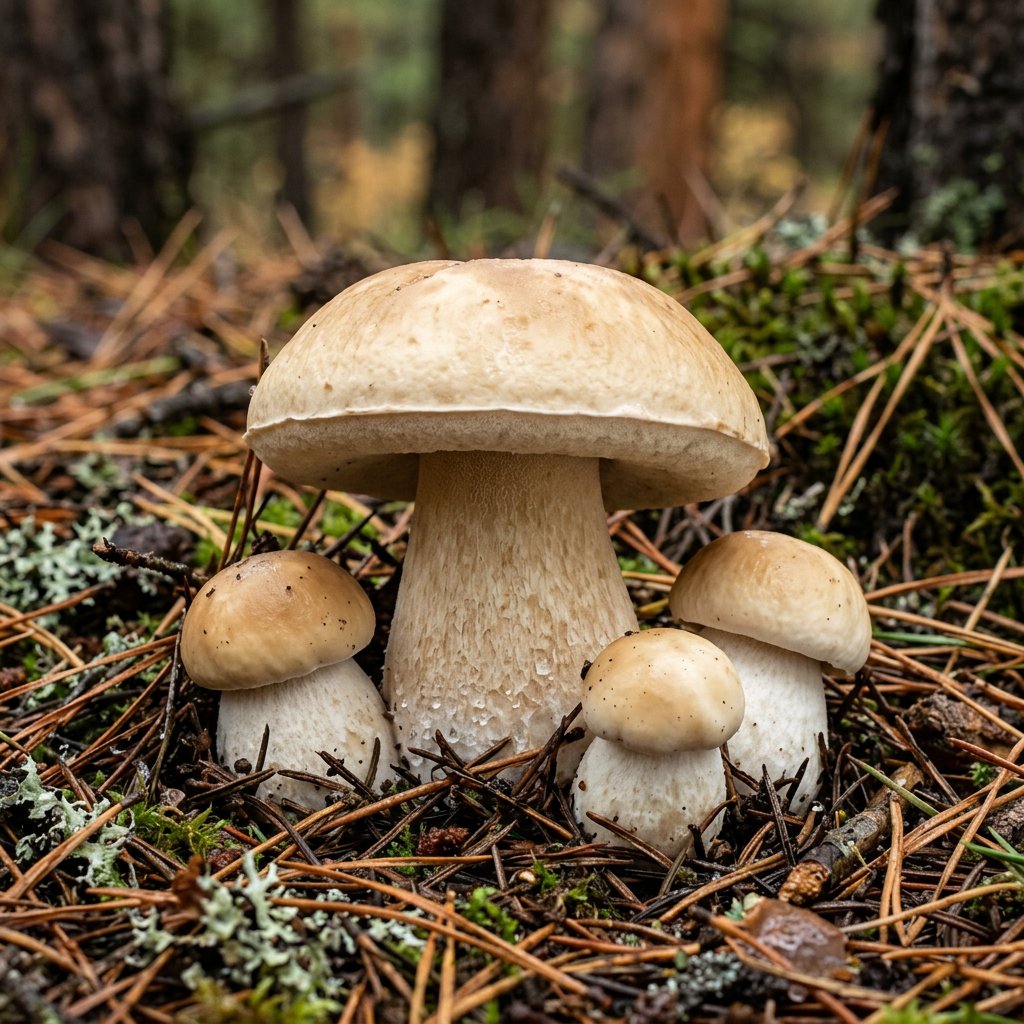
Often called the "White King," Boletus barrowsii is the desert-loving cousin of the world-famous Porcini. While most boletes boast brown or reddish caps, this mushroom stands out like a pale moon against the forest floor. It was named in honor of Charles "Chuck" Barrows, a legendary amateur mycologist who first documented its unique characteristics in the mountains of New Mexico.
🔍 How to Identify
- ⚪ The Cap: Large and fleshy, ranging from 6 to 25 cm across. It is uniquely pale, varying from a creamy white to a light buff or "biscuit" color.
- 🧽 The Pores: Instead of gills, the underside features a spongy surface. These pores are white when young, eventually turning a dingy yellow-green as the mushroom matures.
- 🕸️ The Stem: Thick, club-shaped, and solid. It is usually covered in a fine, white, net-like pattern known as "reticulation," especially near the top.
- ✂️ No Bruising: Unlike many other boletes, the white flesh of Boletus barrowsii does not change color or turn blue when cut or bruised.
🌲 Habitat & Ecology
- 🌲 Tree Partners: This mushroom is "mycorrhizal," meaning it lives in a symbiotic relationship with trees. In the Southwest, it is most commonly found under Ponderosa Pine, while in California, it often hides under Live Oaks.
- 🌦️ Monsoon Specialist: It is a summer and early autumn fungus. In high-altitude regions, it is famous for "flushing" (fruiting) suddenly after the first heavy monsoon rains of the season.
⚠️ Safety & Toxicity
- 🚫 WARNING: Never consume any wild mushroom unless you have confirmed the identity with a local expert. While Boletus barrowsii is a "choice edible," misidentification can be dangerous.
- 🤢 Look-alikes: Beginners may confuse it with toxic "Satan's Boletes" or other red-pored species. A key safety check for this specific mushroom is the lack of blue staining; if it turns blue instantly when sliced, it is not a White King.
- 🐕 Pets: As with most wild fungi, keep dogs away from them, as their digestive systems can react much more violently to raw wild mushrooms than humans'.
✨ Fun Fact
Despite its ghostly, washed-out appearance, the White King is considered just as delicious and aromatic as the European Porcini. It is so highly prized that some foragers in New Mexico and Arizona keep their "secret patches" a closely guarded family secret for decades!
More Details
| Hymenium Type | Pores |
| Stipe Character | Bare Stipe |
| Spore Print Color | Olive |
| Mushroom Cap Shape | Convex Mushroom Cap |
| Hymenium Attachment | Adnate Hymenium Attachment |
| Mushroom Ecological Type | Mycorrhiza |







