Info
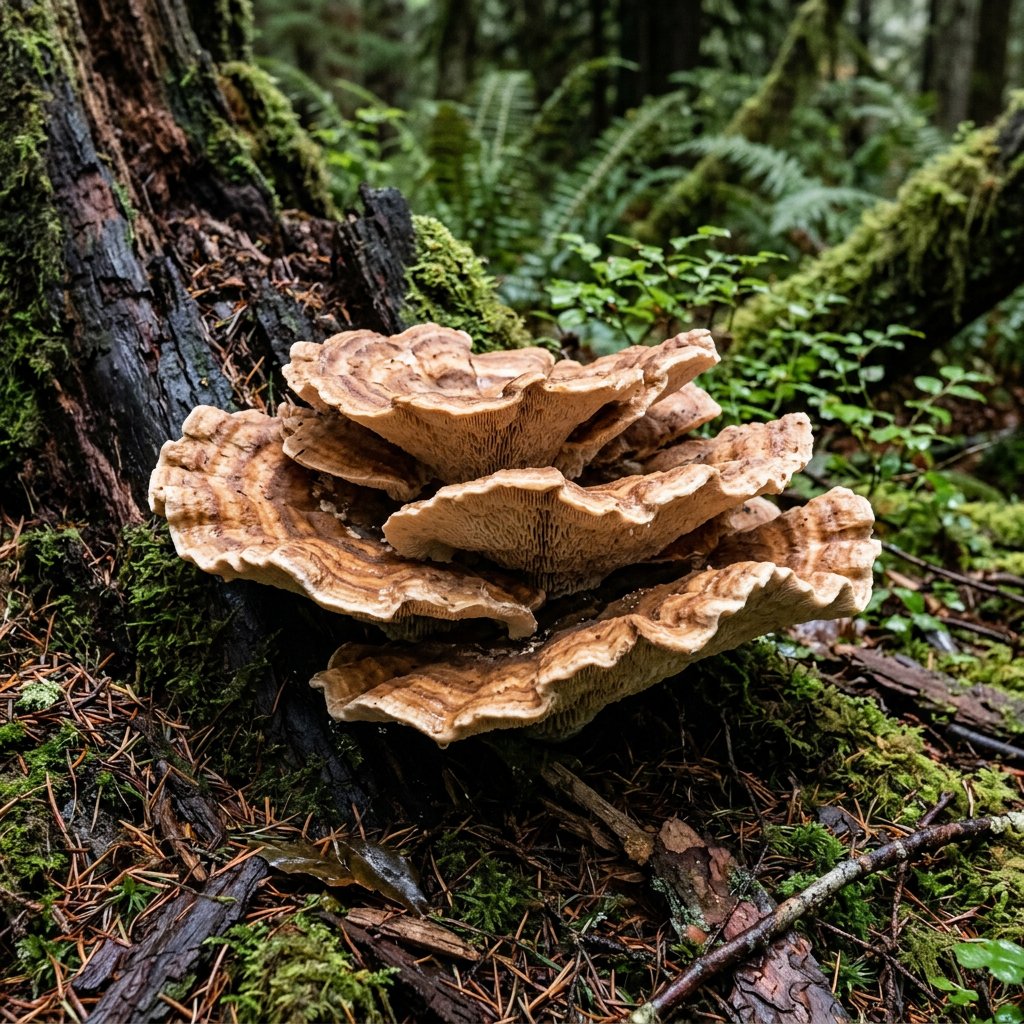
Often called the West Coast Polypore, this massive mushroom looks like a ruffled bouquet of beige velvet emerging from the base of ancient trees. While it lacks the celebrity status of its cousin, the "Hen of the Woods," its presence signals a deep, complex relationship with the old-growth forests of the Pacific Northwest. In the misty woods of the coast, finding one of these giant rosettes feels like discovering a hidden forest treasure.
🔍 How to Identify
- 🎨 Cap Appearance: Large, overlapping fan-shaped brackets that can reach the size of a dinner plate. They are velvety to the touch and colored in muted, concentric zones of cream, ochre, and earthy brown.
- 🕳️ The Underside: This species has no gills. Instead, the underside is a white to cream-colored pore surface. If you look closely, the pores are angular and slightly "toothy" as the mushroom ages.
- 🍄 Growth Habit: It grows in a dense, multi-layered rosette. These clusters can be enormous, sometimes weighing several pounds and appearing to grow directly out of the soil (though they are actually attached to tree roots).
🌲 Habitat & Ecology
- 🌲 Conifer Companion: You will almost exclusively find this mushroom at the base of living or dead conifers, particularly Hemlock, Fir, and Spruce. It is a "butt rot" fungus, meaning it decays the heartwood at the base of the tree.
- 🏔️ Mountain Dweller: True to its name (occidentalis meaning "western"), it is a specialist of western North American mountain ranges, appearing in late summer and autumn when the rains begin to soak the forest floor.
⚠️ Safety & Toxicity
- 🛑 WARNING: While not considered a deadly mushroom, Bondarzewia occidentalis is not recommended for consumption.
- 🤢 Gastrointestinal Risk: While some guides list young specimens as edible, they are notoriously bitter and can cause significant stomach upset. As they mature, they become "corky" and as tough as a piece of leather, making them impossible to chew or digest.
- 🐾 Pet Safety: Keep dogs away from large polypores; while not toxic in a traditional sense, the fibrous texture can cause intestinal blockages in smaller animals.
✨ Fun Fact
🧬 For decades, mycologists thought this was the exact same mushroom as the European Bondarzewia montana. It wasn't until DNA sequencing became common in the early 2000s that scientists realized the West Coast version was a completely unique species that had been "hiding" in plain sight!
More Details







