Info
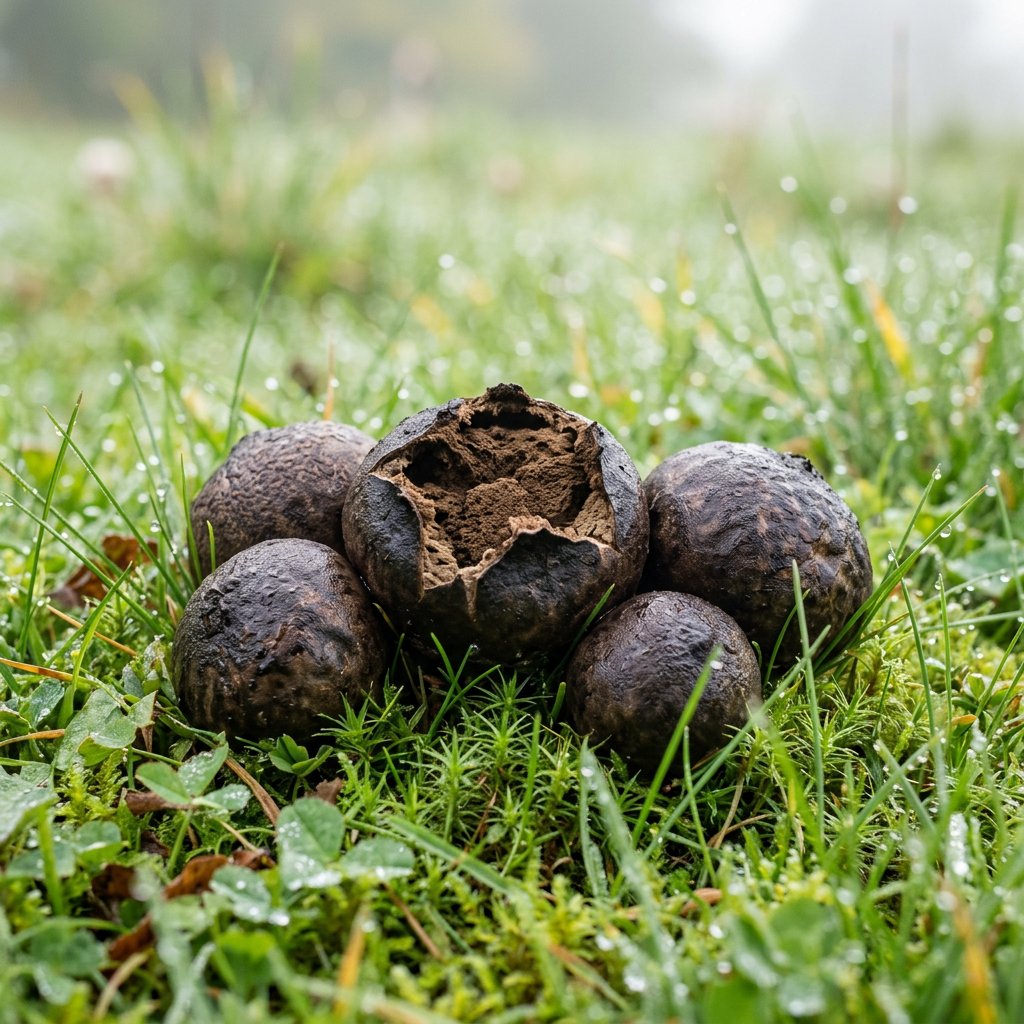
Often called the Blackening Puffball, this little fungus starts its life looking like a pristine white golf ball lost in the grass. As it matures, it undergoes a dramatic transformation, shedding its outer skin to reveal a dark, metallic-looking sphere that persists in the environment long after other mushrooms have withered away. In older English folklore, these were sometimes called "puckfists," thought to be the work of mischievous spirits or "Puck" himself.
🔍 How to Identify
- ⚪ The Shape: It is almost perfectly spherical (globose) and lacks any visible stem or stalk. It typically grows to about the size of a walnut or a small lime.
- 🌑 The Color Shift: Initially pure white and slightly textured, the outer skin soon flakes away to reveal a smooth, leathery inner layer that turns lead-grey and eventually a deep, brownish-black.
- 💨 The Spore Release: At the very top of the mature mushroom, a small, irregular hole (apical pore) develops. When raindrops hit the puffball or an animal brushes past, a "puff" of dark spores is ejected like a tiny volcanic eruption.
🌲 Habitat & Ecology
- 🌱 Grassy Domains: You will most likely find these in old pastures, meadows, and coastal heaths. They prefer sunny spots with short grass where they aren't overshadowed by taller plants.
- 🌬️ The Tumbler: Unlike many fungi that rot in place, the Blackening Puffball often breaks free from its root-like threads when dry. It becomes a "tumbleweed" of the fungus world, rolling across the field in the wind and spreading its spores as it bounces.
⚠️ Safety & Toxicity
- 🛑 WARNING: Never consume any puffball unless you are 100% certain of its identity. Many toxic mushrooms, including the deadly Amanitas, look like small white balls when they are young.
- ⚠️ The Inside Test: If being considered for food (when young), the mushroom must be sliced vertically. The interior must be solid, pure white, and uniform like mozzarella cheese. If there is any yellowing, browning, or a visible outline of a developing "cap and gills" inside, it is either too old or a dangerous lookalike (like a Pigskin Poison Earthball).
- 🐶 Pet Safety: Mature puffballs can be hazardous to curious dogs. If a dog bites into a mature one, the massive cloud of spores can be inhaled, leading to a rare but serious lung inflammation called Lycoperdonosis.
✨ Fun Fact
- 🩸 Nature's Band-Aid: Before the age of modern medicine, the dry, papery skins of mature puffballs were often used in rural areas to stanch bleeding. The fine spores were believed to have styptic properties, helping blood to clot quickly on small cuts and wounds.
More Details
| Hymenium Type | Gleba |
| Spore Print Color | Brown |
| Mushroom Cap Shape | No Mushroom Cap |
| Hymenium Attachment | No Hymenium Attachment |
| Mushroom Ecological Type | Saprobiont |







