Info
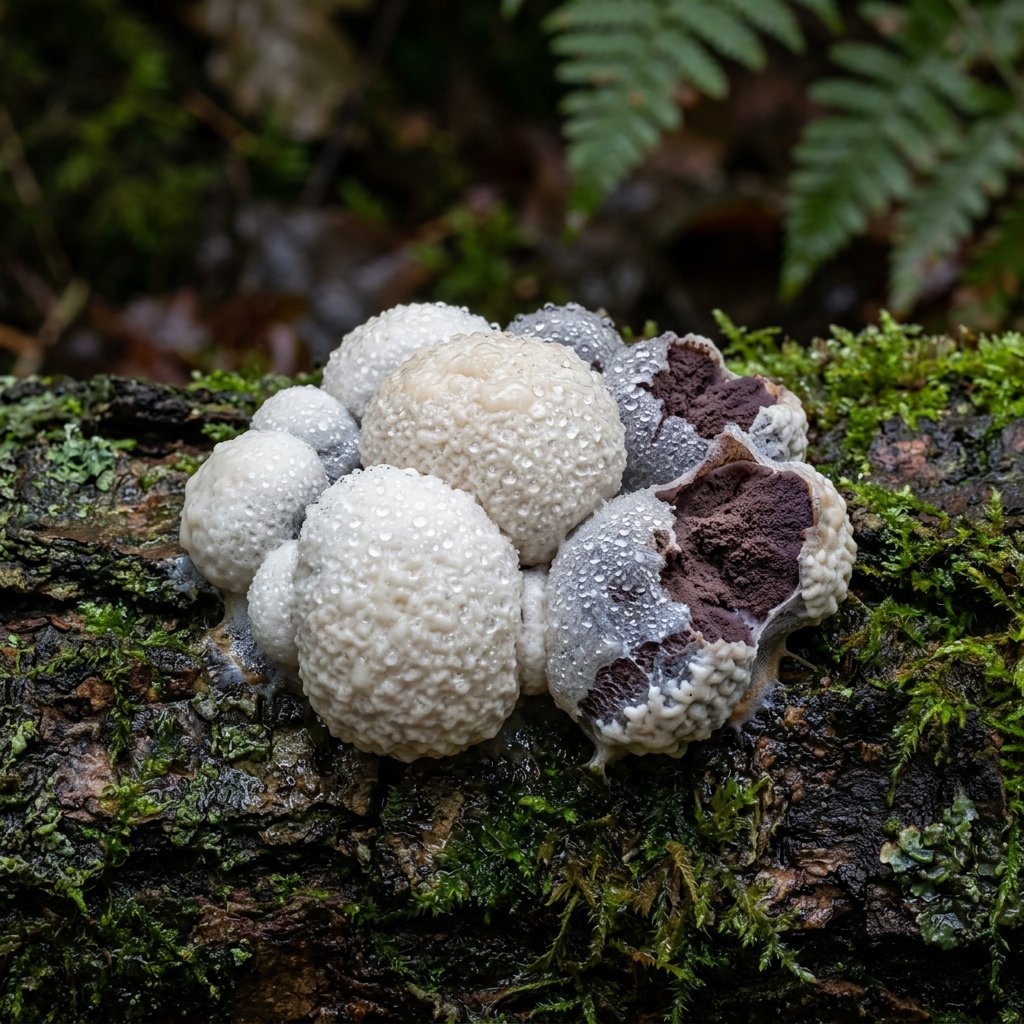
Often called the "Tapioca Slime Mold," this fascinating organism looks less like a mushroom and more like a spilled bowl of cottage cheese or breakfast porridge. While it is technically a Myxomycete (a slime mold) rather than a true fungus, it is a frequent guest in damp woodlands. In European folklore, these sudden, mysterious white masses appearing on logs were sometimes called "Star Jelly," believed to be the residue of meteor showers.
🔍 How to Identify
- 🥣 Appearance: It starts as a large, white, frothy mass that looks remarkably like tapioca pudding. As it matures, it hardens and develops a crust.
- 🌑 Color Shift: While it begins bright white, it eventually turns a dark, leaden grey or deep brownish-purple as it prepares to release its spores.
- 🍄 Structure: It forms an "aethalium," which is a large, cushion-shaped fruiting body. It can grow quite large, sometimes covering several inches of a log in a thick, bubbly layer.
🌲 Habitat & Ecology
- 🪵 The Substrate: You will almost always find it on very damp, decaying wood. It has a particular fondness for rotting logs and stumps of deciduous trees like Birch, Alder, and Poplar.
- 🦠 The Hunter: Before it turns into the "tapioca" state, the organism exists as a plasmodium—a giant, single-celled "blob" that slowly creeps across the wood to hunt and eat bacteria, fungal spores, and decaying organic matter.
⚠️ Safety & Toxicity
- 🚫 Status: NON-TOXIC BUT INEDIBLE. While the Tapioca Slime Mold is not considered poisonous, it is certainly not food. Its texture is unpleasant, and as it matures, it turns into a dry, dusty mass of spores.
- 🐾 Pets & Garden: It is harmless to pets, children, and living plants. It is a decomposer, meaning it is a sign that your garden's wood mulch or old stumps are breaking down naturally into healthy soil.
✨ Fun Fact
🏃 The Great Crawler: Even though it looks stationary, during its "plasmodium" stage, Brefeldia maxima can actually move! It creeps along the forest floor at a speed of about a few millimeters per hour, searching for the best spot to settle down and transform into the "tapioca" form you see.
More Details