Info
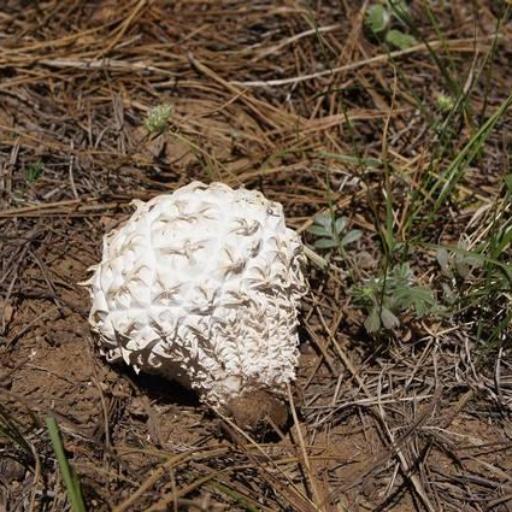
Known as the Sierran Puffball or the Sculpted Puffball, this fungal masterpiece looks more like a hand-carved geometric sculpture than a living organism. Found primarily in the high-altitude forests of the western United States, it is celebrated by hikers and photographers for its striking, "origami-like" appearance. It emerges from the forest floor like a bright white mountain gem, standing out vividly against the dark pine needles.
🔍 How to Identify
- 🍄 The "Pyramids": The most distinct feature is the surface, which is covered in large, pointed, pyramid-shaped warts. These scales often have a hooked tip, giving the mushroom a "toothed" look.
- ⚪ The Gleba (Interior): When young and fresh, the inside is pure white and firm, similar to the texture of cream cheese or marshmallow.
- 📐 Shape & Size: It typically grows in a pear or club shape, reaching up to 6 inches (15 cm) in height. Unlike many other puffballs, it has a distinct, thick stalk-like base.
- 🍂 Color Shift: As it matures, the pristine white exterior fades to a dull tan or yellow-brown, and the internal spore mass turns into a dusty, olive-brown powder.
🌲 Habitat & Ecology
- 🏔️ High Altitude Specialist: This is a mountain-loving mushroom. You are most likely to spot it in coniferous forests at elevations between 2,500 and 9,000 feet, particularly in the Sierra Nevada and Cascade ranges.
- 🌲 Conifer Companion: It thrives in the organic "duff" (fallen needles and debris) under fir and pine trees. It plays a vital role as a saprobe, breaking down organic matter to recycle nutrients back into the mountain soil.
- ❄️ Snow Melter: It often appears shortly after the heavy mountain snowpacks begin to melt in late spring or early summer, taking advantage of the saturated ground.
⚠️ Safety & Toxicity
- 🚨 WARNING: While the Sierran Puffball is generally considered edible when the interior is pure, solid white, it should never be consumed once the inside begins to turn yellow, green, or brown, as this can cause severe digestive upset.
- 🛑 The Slice Test: Always slice a puffball vertically before considering it for the kitchen. If you see the outline of a "baby mushroom" (gills and a cap) inside, you have accidentally picked a deadly Amanita button, not a puffball.
- 🧤 General Caution: Foraging requires 100% certainty. If the "sculpted" pyramids are missing or the mushroom feels mushy, leave it in the wild.
✨ Fun Fact
The species name sculpta is Latin for "carved" or "sculpted." Because of its unique geometric patterns, it is often cited as one of the most beautiful fungi in North America and is a favorite subject for "macro" nature photographers.
More Details
| Hymenium Type | Gleba |
| Spore Print Color | Brown |
| Mushroom Cap Shape | No Mushroom Cap |
| Mushroom Ecological Type | Mycorrhiza |