Info
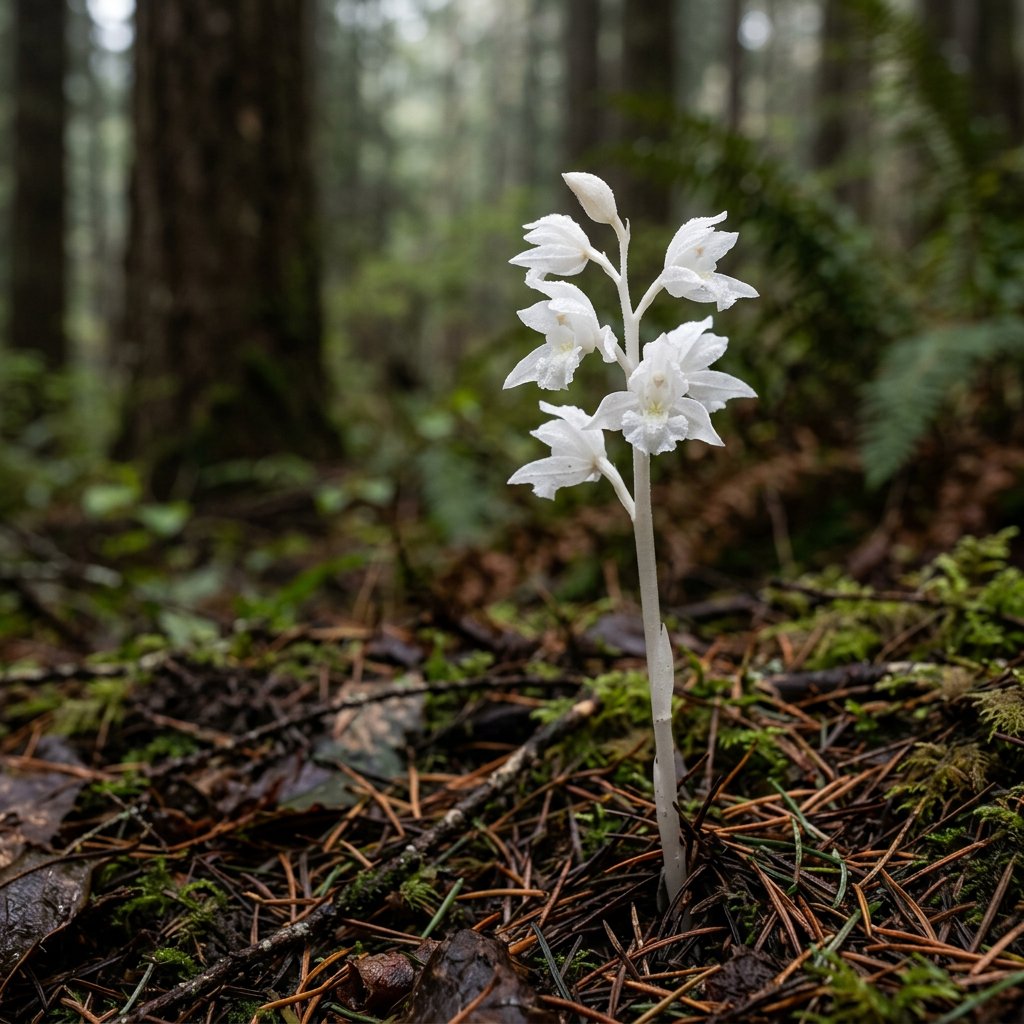
Often called the "Phantom Orchid" or "Snow Orchid," this ethereal beauty lives up to its name by appearing like a ghostly spirit on the dark, shaded floors of evergreen forests. Unlike almost every other plant you know, it has completely abandoned the color green and the process of photosynthesis, opting instead for a mysterious, parasitic lifestyle that relies entirely on underground fungal networks.
🔍 How to Identify
- 🤍 Pearly White Appearance: The entire plant—from the stem to the tiny, scale-like leaves—is a stark, waxy white because it contains no chlorophyll.
- 🌸 Orchid Bloom Structure: It produces small, delicate flowers that look like miniature porcelain sculptures, often featuring a tiny splash of yellow-gold on the "lip" of the petal.
- 📏 Height and Form: It typically grows between 8 to 20 inches tall, standing out sharply against the dark browns and greens of the forest floor.
🌲 Habitat & Ecology
- 🍄 The Fungal Connection: This plant is a "mycoheterotroph." It doesn't get energy from the sun; instead, it "tricks" specific underground fungi (like Thelephora) into giving it nutrients that the fungi have gathered from nearby trees.
- ⛰️ Old-Growth Resident: You will mostly find this orchid in the moist, undisturbed coniferous forests of Western North America, often hiding in deep leaf litter where it is cool and heavily shaded.
⚠️ Safety & Toxicity
- 🛑 Status: Not for consumption. While not known to be deadly toxic, it is a rare and delicate species that should never be eaten or handled roughly.
- ✋ Do Not Transplant: The Phantom Orchid is incredibly sensitive. Because it relies on a highly specific relationship with local underground fungi, it is almost impossible to grow in a garden. Digging one up is a guaranteed death sentence for the plant.
✨ Fun Fact
The Phantom Orchid is a master of patience; it can remain completely dormant underground for several years without ever sprouting a single stem, waiting for the perfect environmental conditions to "haunt" the forest once again.
More Details