Info
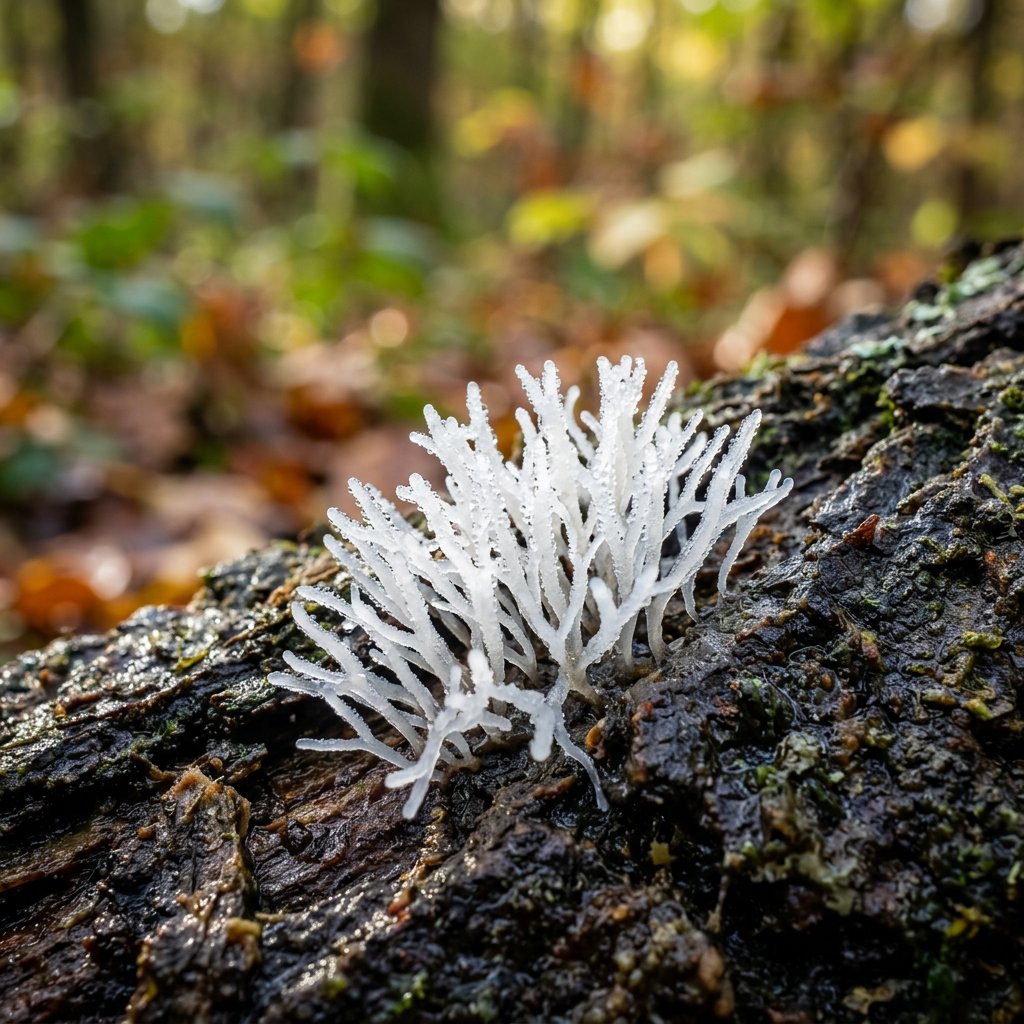
Often called the Coral Slime Mold, Ceratiomyxa fruticulosa is one of nature’s most delicate "ghosts." Though it looks like a fungus, it is actually a Protist—a shape-shifting organism that spends most of its life as a single-celled amoeba before gathering together to form these icy, crystalline structures. It is a common sight in damp forests, appearing like miniature white coral reefs growing out of ancient, decaying logs.
🔍 How to Identify
- ❄️ The Body: Unlike a typical mushroom with a cap and stem, this organism consists of clusters of tiny, translucent white "fingers" or pillars.
- 🕯️ Texture: It has a frosty, waxy, or watery appearance. The structures are incredibly fragile and will often dissolve into a milky substance if touched.
- 🌬️ Spore Placement: Most fungi hide their spores in gills or pores, but the Coral Slime Mold is unique—it carries its spores on the outside surface of its stalks.
🌲 Habitat & Ecology
- 🪵 Substrate: You will almost always find it on very wet, well-rotted wood (logs, stumps, or thick bark) that has lost its bark and is starting to crumble.
- 💧 The "Pulse": It appears suddenly after heavy summer rains. Before it forms these "coral" stalks, it exists as a "plasmodium"—a creeping, jelly-like sheet that moves across the wood to find the perfect spot to fruit.
- 🦠 Dietary Role: It doesn't actually eat the wood; instead, it acts as a tiny predator, "hunting" and consuming bacteria, yeast, and fungal spores found on the decaying log.
⚠️ Safety & Toxicity
- 🚫 Status: NOT EDIBLE. While slime molds are not generally known to be toxic to humans, they have no culinary value and are far too small and watery to be considered food.
- 🐾 Pets & Kids: It is generally considered harmless if accidentally touched or stumbled upon in the garden, as it lacks the defense toxins found in many true mushrooms.
- ☁️ Allergies: Like all spore-bearing organisms, those with severe respiratory sensitivities should avoid inhaling the area directly if the mold has dried out and become dusty.
✨ Fun Fact
Slime molds are considered "intelligent" by scientists! Despite having no brain or nervous system, species in this group can navigate mazes, "remember" where they have found food, and even solve complex network problems more efficiently than some computer algorithms.
More Details







