Info
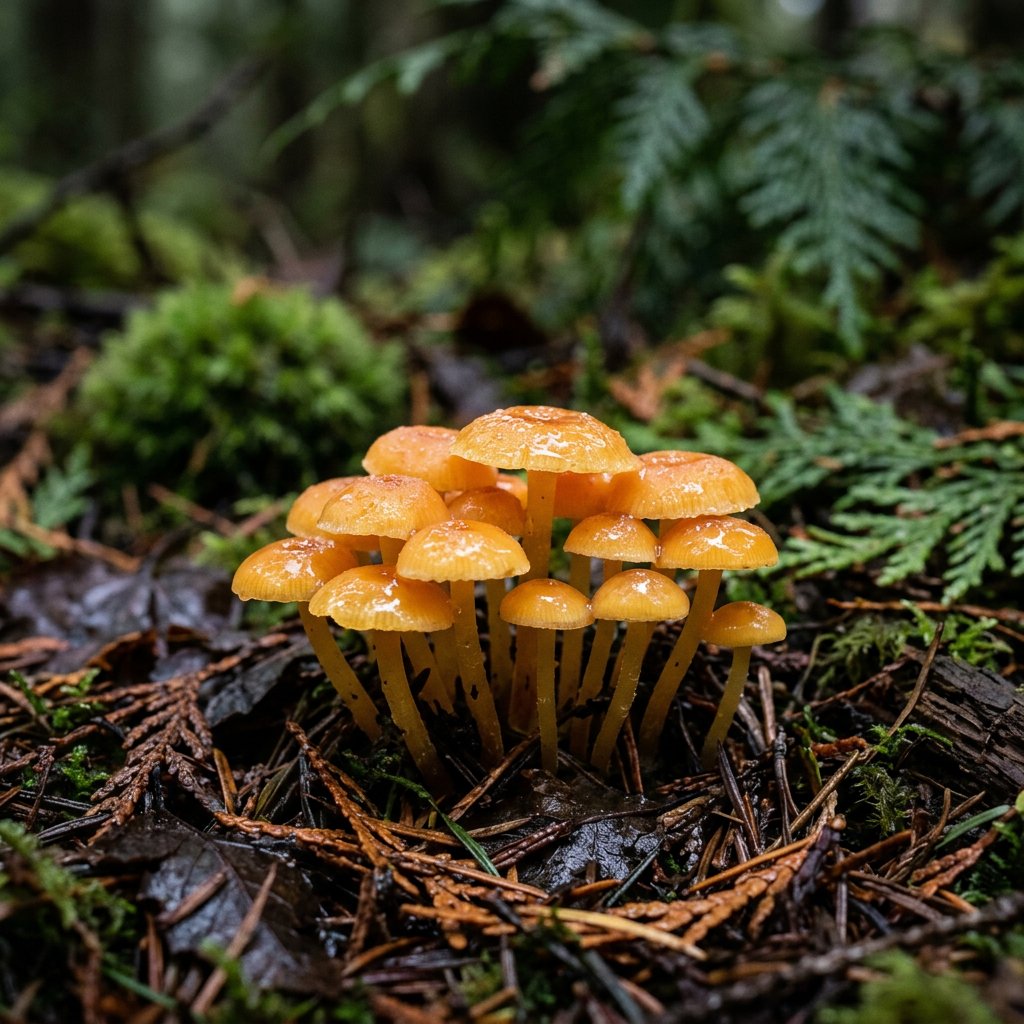
Often called the Orange Moss Agaric, this tiny fungal gem looks like a stray drop of molten sun resting on the forest floor. These vibrant mushrooms are a favorite for macro-photographers because their brilliant orange hues create a stunning contrast against the deep green mosses they call home. While they are too small to be of interest to foragers, their cheerful presence is a highlight of any damp woodland hike.
🔍 How to Identify
- 🍄 The Cap: Measuring only 1 to 3 cm across, the cap starts slightly rounded but quickly develops a deep central depression, giving it a classic "navel" or funnel shape.
- 🧡 The Gills: The gills are thick, widely spaced, and "decurrent," meaning they run partway down the stem rather than stopping at the top.
- 🦒 The Stem: The stalk is slender, smooth, and typically the same radiant orange or yellow-orange as the cap, often looking slightly translucent when wet.
🌲 Habitat & Ecology
- 🌿 Mossy Companions: This species is almost exclusively found growing among mosses or on heavily decayed, moss-covered wood. It is particularly fond of acidic environments beneath pine and spruce trees.
- 💧 Rain Lovers: Look for them during the late summer and autumn. They are "hygrophanous," meaning their color can change and fade slightly as they dry out, so they look most vibrant immediately after a rainstorm.
⚠️ Safety & Toxicity
- 🛑 WARNING: Chrysomphalina aurantiaca is considered inedible. It is not a traditional "culinary" mushroom, and its chemical properties are not well-documented enough to be deemed safe for consumption.
- 🚫 Look-alike Risk: Small orange mushrooms can be difficult to distinguish from toxic species (like certain Galerina or Omphalotus species). It is best to treat this mushroom as a strictly "visual" forest treasure.
✨ Fun Fact
The name Chrysomphalina is derived from the Greek words for "gold" (chryso-) and "navel" (omphalos). This perfectly describes its golden-orange color and the belly-button-like dip in the center of its tiny cap!
More Details