Info
Often referred to as "Spruce Rust" or "Needle Rust," Chrysomyxa is a fascinating genus of fungi that swaps the traditional mushroom "umbrella" for a life of vibrant, powdery colors. These fungi are master hitchhikers, moving between spruce trees and forest floor shrubs to complete their complex life cycles. In many northern cultures, the dense, tangled branch clusters they cause are known as "Witches' Brooms," once believed to be the resting spots of forest spirits or hags flying through the night.
🔍 How to Identify
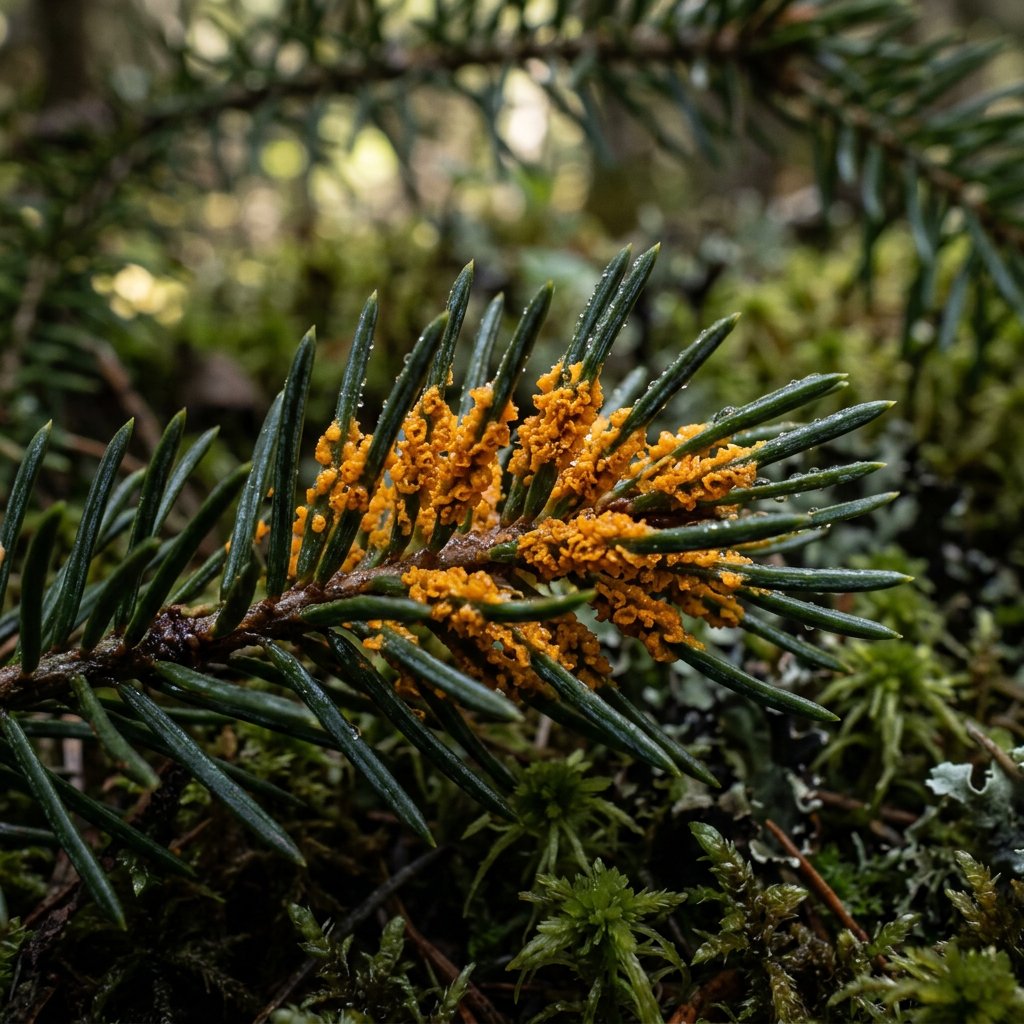
- 🟠 The Rust Blisters: Unlike fleshy mushrooms, these appear as tiny, neon-orange or golden-yellow powdery blisters (aecia) bursting from the needles of spruce trees or the leaves of rhododendrons.
- 🧹 Witches' Brooms: Look for "abnormal" growth on spruce branches—thick, chaotic bunches of twigs that look like messy bird nests or upside-down brooms.
- 🍂 Seasonal Glow: In mid-to-late summer, infected trees may appear to be "glowing" from a distance due to the sheer volume of bright orange spores covering the foliage.
🌲 Habitat & Ecology
- 🌲 Dual-Life Strategy: These fungi are "heteroecious," meaning they require two different host plants to survive. They typically spend part of their life on Spruce trees (Picea) and the other part on plants like Labrador Tea, Bog Laurel, or Rhododendrons.
- 💧 Boreal Favorites: They are most commonly found in cool, damp boreal forests, peat bogs, and high-altitude coniferous zones where their two favorite host plants grow side-by-side.
⚠️ Safety & Toxicity
- 🛑 WARNING: Chrysomyxa is a micro-fungus and does not produce a fleshy, edible fruiting body. It is strictly non-edible and should never be consumed.
- 🌬️ Respiratory Caution: While not toxic to the touch, disturbing a heavily infected branch can release clouds of fine spores. Avoid inhaling these spores, as they can cause minor respiratory irritation or allergic reactions in sensitive individuals.
✨ Fun Fact
The "Witches' Brooms" created by this fungus are actually vital for forest biodiversity! These dense branch clusters provide high-quality nesting real estate for Northern Flying Squirrels and several species of forest birds that need extra protection from predators.
More Details







