Info
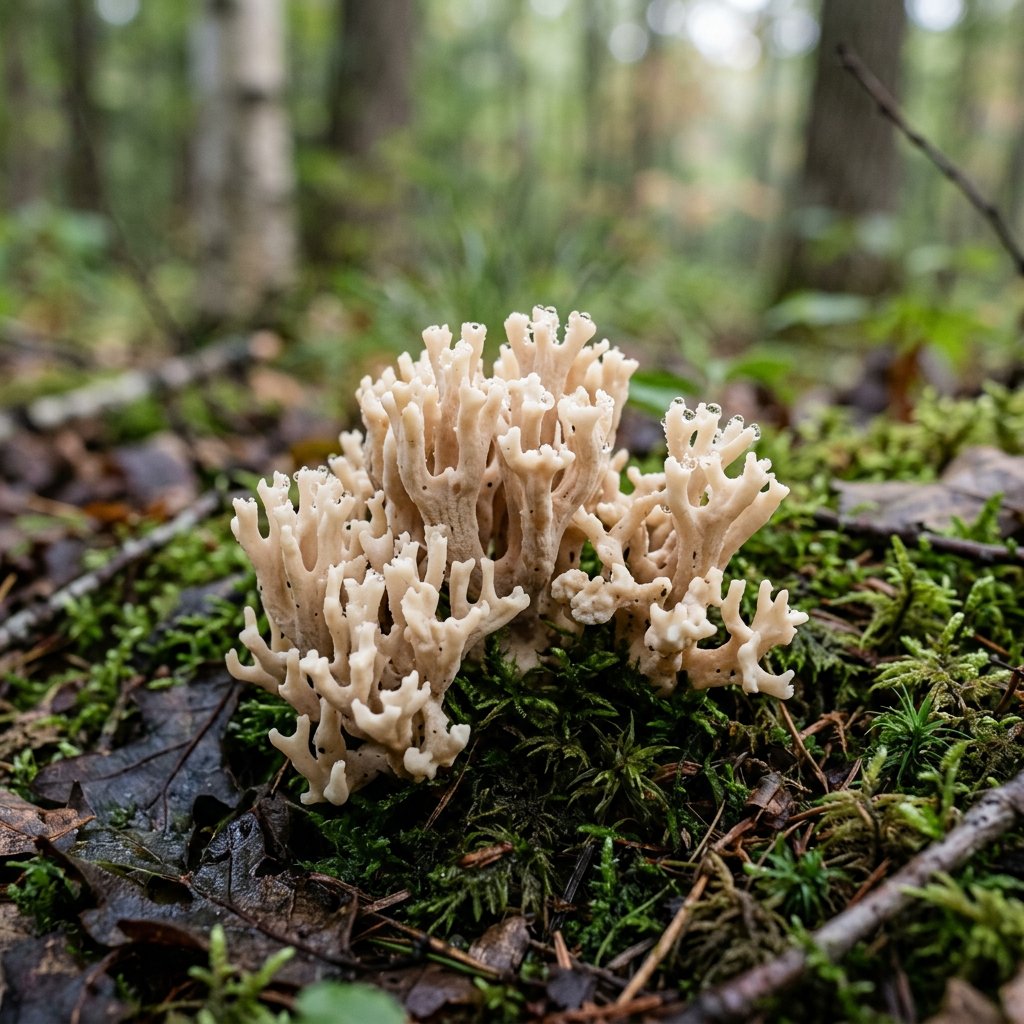
Often called the "Wrinkled Club" or "Fairy Club," Clavulina subrugosa is a minimalist beauty of the forest floor. Unlike its flamboyant coral cousins that branch out like underwater reefs, this fungus prefers a simpler, more upright look, resembling tiny, pale fingers reaching through the moss. In old European folklore, these small club fungi were sometimes whispered to be the discarded walking sticks of forest gnomes.
🔍 How to Identify
- 🍄 Body Shape: Simple, upright clubs that are mostly unbranched. If they do branch, it is usually just once or twice near the very tip.
- 🕯️ Texture & Surface: The surface is waxy and "subrugose," which is a botanical term meaning it has light wrinkles or longitudinal furrows rather than being perfectly smooth.
- 🎨 Color Palette: Usually a clean, creamy white to pale ivory, though they can transition to a yellowish-tan or dull greyish hue as they age or dry out.
🌲 Habitat & Ecology
- 🌿 Mossy Neighbors: This species is most frequently found peeking through thick carpets of moss or nestled within damp leaf litter in both coniferous and deciduous forests.
- 🤝 Tree Partners: As a mycorrhizal fungus, it forms a sophisticated underground partnership with tree roots, trading nutrients for sugars—a vital relationship that keeps the forest ecosystem healthy.
⚠️ Safety & Toxicity
- 🚫 WARNING: Do not consume. While some members of the Clavulina genus are technically edible, they are frequently confused with toxic species of "Coral" or "Club" fungi.
- 🧪 Identification Risk: Many club fungi look identical to the naked eye and require a microscope to distinguish. Additionally, Clavulina species are often attacked by a parasitic fungus that can turn them grey or black, potentially making them toxic if ingested.
- 🐾 Pets & Kids: Keep curious pets and children away, as ingestion may lead to gastrointestinal distress.
✨ Fun Fact
Clavulina subrugosa often plays host to a "fungus on a fungus." A tiny black parasite called Helminthosphaeria clavariarum frequently infects it, slowly turning the pristine white club into a charcoal-grey spike, making it look like a completely different species!
More Details







