Info
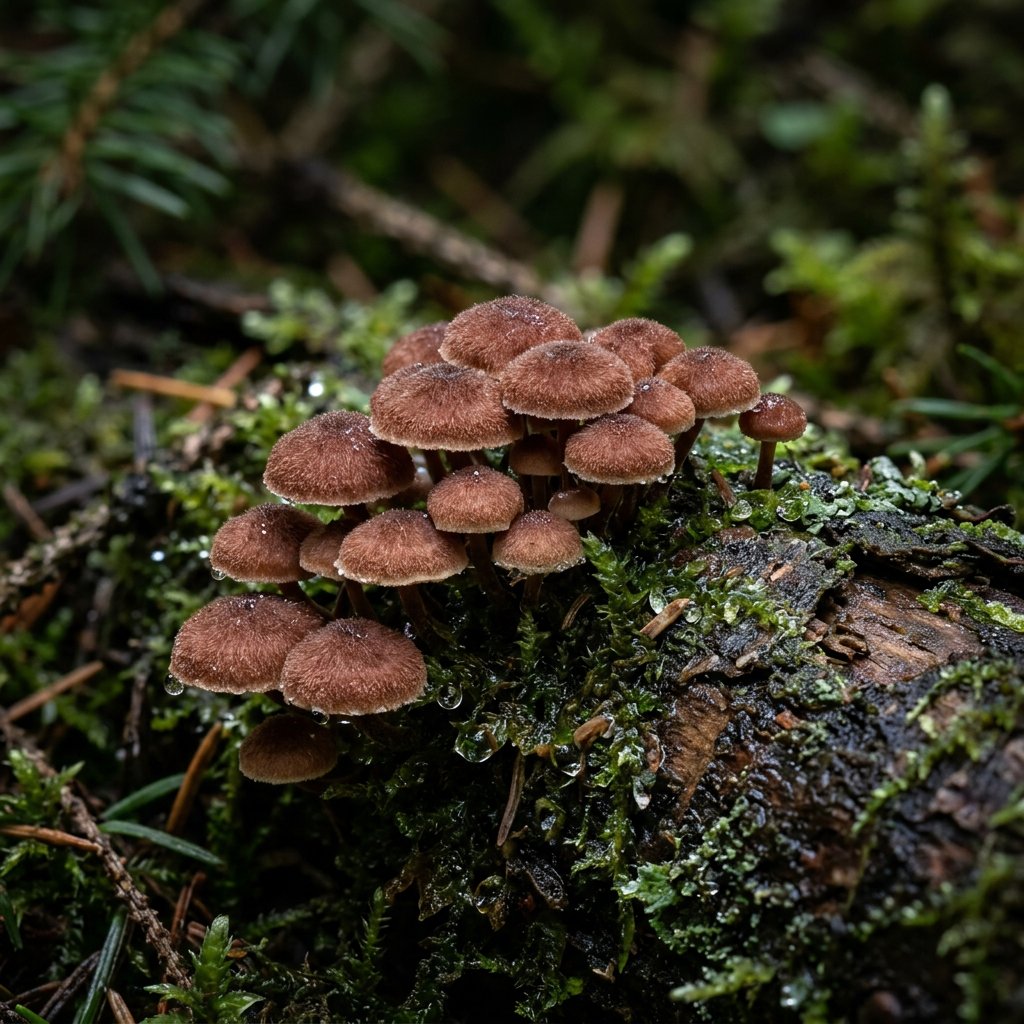
Known as the "Hanging Polypore," Coltriciella dependens is a tiny architectural marvel of the fungal world. Unlike most mushrooms that stand tall on the forest floor, this species prefers to dangle gracefully from the underside of rotting logs like a miniature, velvet-covered chandelier. It is a rare find for many foragers, often overlooked because it hides in the shadows of decaying wood.
🔍 How to Identify
- 🔔 The Cap: Small, bell-shaped, or conical, usually measuring only 1 to 4 centimeters across. It has a distinctive rusty-brown or cinnamon color with a finely velvety or hairy texture.
- 🕳️ The Pores: Instead of gills, the underside features a honeycomb-like surface of angular pores. These pores are relatively large for the mushroom's size and share the same warm brown hue as the cap.
- 🔗 The Stem: A short, central or slightly off-center stalk that attaches to the top of the cap, allowing the mushroom to hang vertically (pendant) from its substrate.
🌲 Habitat & Ecology
- 🪵 Woodland Preference: This fungus is a "saprobe," meaning it breaks down dead organic matter. You will almost exclusively find it attached to the underside of very decayed logs or charred wood, particularly in coniferous or mixed forests.
- 🔥 The Fire Connection: It has a noted affinity for burnt-over areas. In some regions, it is found emerging from the scorched roots or stumps of pine trees, playing a vital role in recycling nutrients back into the soil after a forest fire.
⚠️ Safety & Toxicity
- 🚫 WARNING: Not for consumption. While Coltriciella dependens is not explicitly listed as a deadly species, it is considered inedible due to its tough, corky texture and the lack of research regarding its chemical makeup.
- 🐾 General Caution: As with all wild fungi found on decaying wood, it should be kept away from curious pets and children, as many wood-rotting species contain compounds that can cause severe gastrointestinal distress.
✨ Fun Fact
The specific epithet dependens is Latin for "hanging down," perfectly describing its unique growth habit. It is one of the few polypores (shelf-style mushrooms) that evolved to have a central stem while still maintaining a hanging, pendant position!
More Details