Info
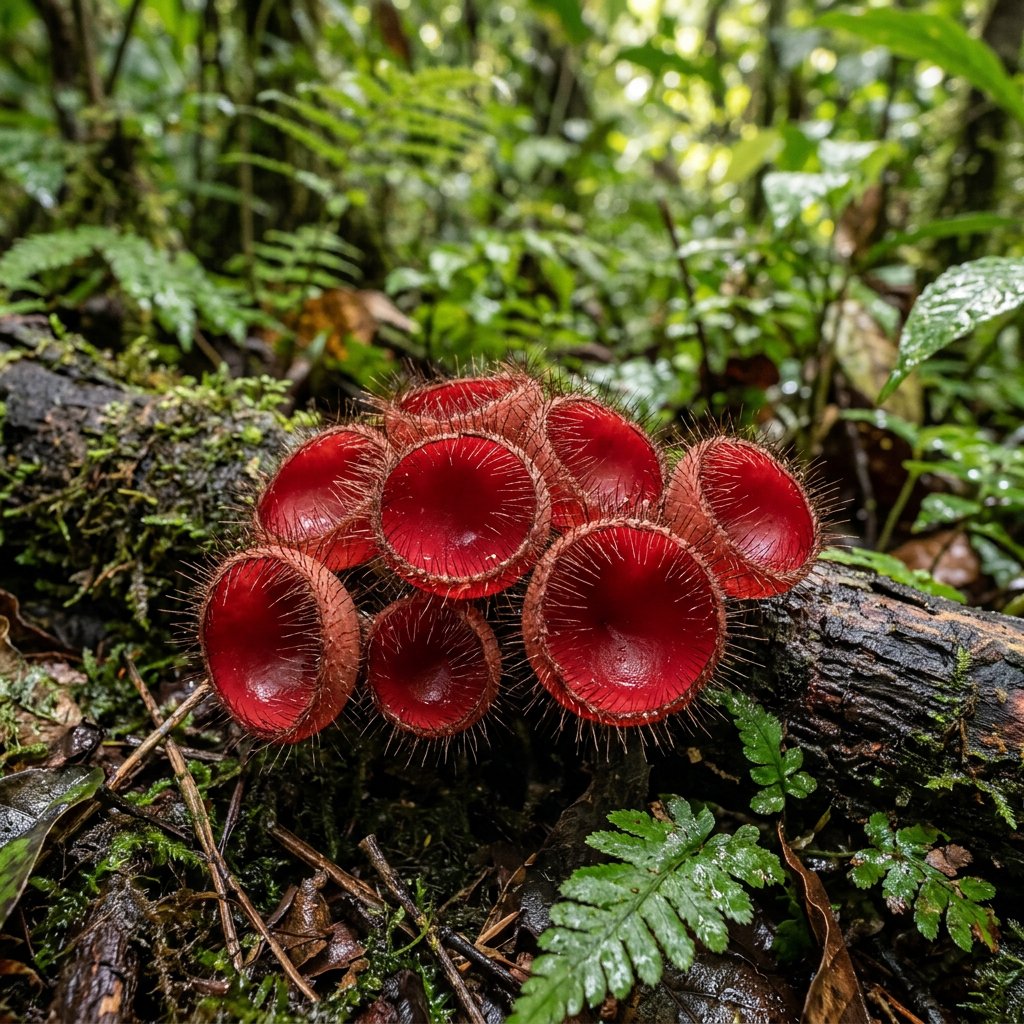
Known as the Bristly Tropical Cup, Cookeina tricholoma looks like a tiny, glowing goblet forgotten by a forest sprite. This vibrant fungus is a hallmark of tropical rainforests, often appearing after heavy rains as a splash of neon red against the dark, decaying wood of the jungle floor. Its most striking feature is the delicate, eyelash-like hairs that fringe its rim, giving it an almost whimsical, "living" appearance.
🔍 How to Identify
- 🍷 The Cup: It features a deep, funnel-shaped cup (apothecium) that is usually bright orange to brilliant scarlet on the inside, where the spores are produced.
- 👁️ The Bristles: The outer surface and the rim are covered in long, stiff, translucent or white hairs called setae. These look like long eyelashes and help distinguish it from its smoother cousins.
- 🏗️ The Stem: The cup sits atop a short, sturdy, pale-colored stalk that anchors it firmly into the decaying wood or fallen branches.
🌲 Habitat & Ecology
- 🪵 Wood Dweller: This is a saprobic fungus, meaning it lives by breaking down dead organic matter. You will almost exclusively find it growing on rotting logs, fallen branches, and twigs in humid, tropical environments.
- ☁️ Humidity Lover: It thrives in high-moisture areas. In the wild, it plays a vital role in the ecosystem by recycling nutrients from dead wood back into the soil, supporting the growth of the surrounding rainforest.
⚠️ Safety & Toxicity
- 🚫 Status: STRICT WARNING: Inedible. While not known to be "deadly" in the way some gill-bearing mushrooms are, Cookeina tricholoma is generally considered inedible due to its tough, leathery texture and lack of nutritional value.
- ✋ Handling: It is safe to touch and photograph, but you should never consume any wild fungus unless you are an expert mycologist. In many tropical regions, similar-looking species can be difficult to distinguish without a microscope.
✨ Fun Fact
If you find a fresh Cookeina cup and gently blow on it or change the air pressure nearby, it may reward you by "puffing." It releases a visible cloud of thousands of microscopic spores all at once, which looks like a tiny burst of forest smoke!
More Details