Info
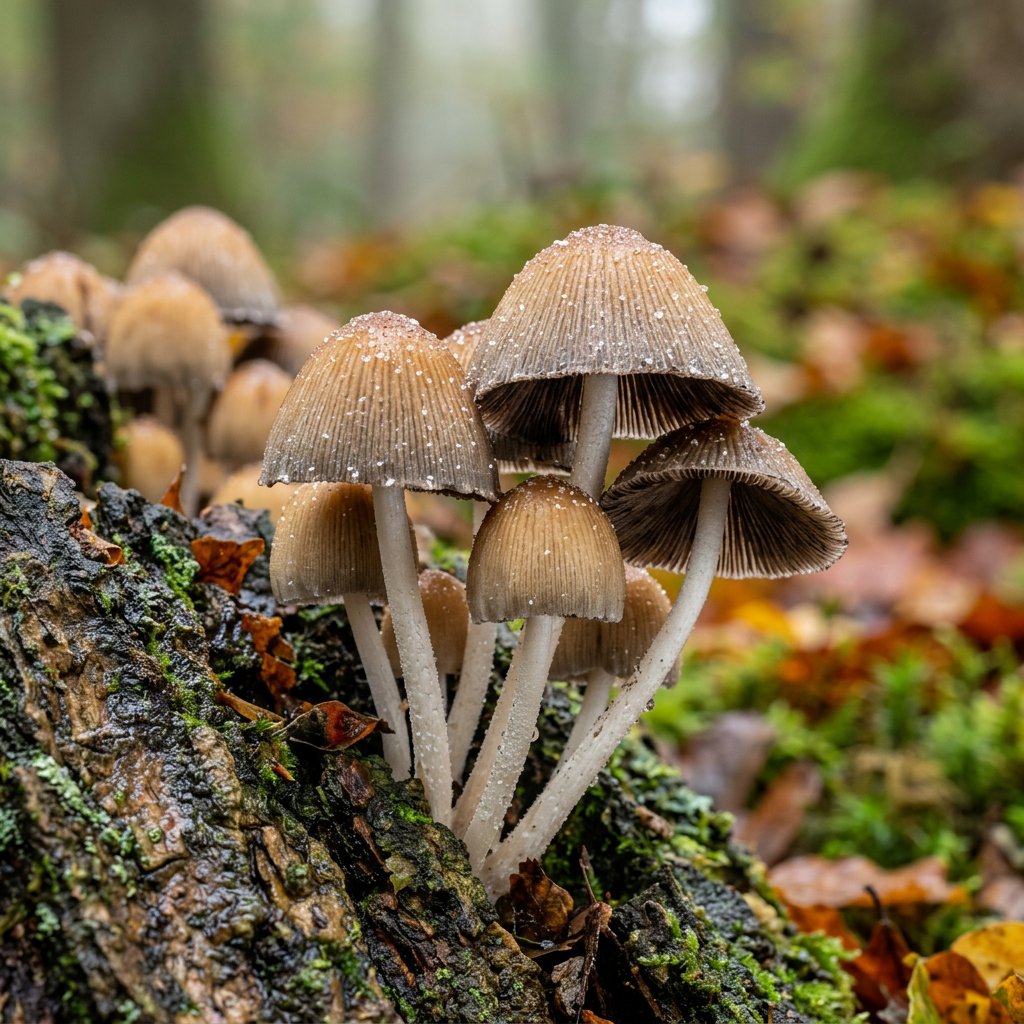
Often called the Glistening Ink Cap or Mica Cap, this charming little mushroom looks like it was dusted with fairy glitter. It is famous for its "magical" disappearing act: as the mushroom matures, its gills turn into a thick, black, inky liquid. You’ll often find them huddling together in massive, crowded families near old tree stumps or buried wood after a refreshing spring rain.
🔍 How to Identify
- ✨ The "Glisten": When young, the bell-shaped cap is covered in tiny, shiny granules that look like salt or mica. These often wash off after a heavy rain.
- 🪟 Ribbed Cap: The cap is a warm tan or tawny brown, featuring deep vertical grooves (striations) that run from the edge toward the center.
- 🖋️ Inky Gills: The gills start off white, then turn grey, and finally dissolve into a black liquid. This process, called deliquescence, helps the mushroom scatter its spores.
- 📏 Slender Stem: The stem is white, hollow, and quite fragile, usually lacking any ring or bulb at the base.
🌲 Habitat & Ecology
- 🪵 The Wood-Eater: While they often appear to be growing from grass, they are actually feeding on decaying wood or dead tree roots buried just beneath the surface.
- 👨👩👧👦 Crowded Clusters: They rarely grow alone. You will typically see dozens, if not hundreds, of caps tightly packed together in a "troop."
- 🌤️ Ephemeral Life: These mushrooms are fast growers. They can pop up overnight after a rainstorm and melt away into black goo by the following afternoon.
⚠️ Safety & Toxicity
- 🛑 WARNING: Never consume any wild mushroom unless you are 100% certain of its identity. Many "LBMs" (Little Brown Mushrooms) are look-alikes and can be dangerously toxic.
- 🍴 Edibility: The Glistening Ink Cap is considered edible, but it must be collected when very young (while the gills are still white) and cooked immediately.
- 🧪 Alcohol Interaction: Unlike its cousin, the Common Ink Cap (Coprinopsis atramentaria), the Glistening Ink Cap is generally considered safe to eat with alcohol. However, many foragers still avoid the combination as a precaution because look-alikes contain coprine, which causes severe nausea when mixed with a drink.
✨ Fun Fact
The black "ink" produced by this mushroom was historically used as actual writing ink! In some cases, it was even mixed with water and used by artists for sketching or by officials to sign documents where they wanted to prevent forgery, as the spores in the ink acted as a biological "fingerprint."
More Details
| Hymenium Type | Lamella |
| Stipe Character | Bare Stipe |
| Spore Print Color | Black |
| Mushroom Cap Shape | Campanulate Mushroom Cap |
| Hymenium Attachment | Adnexed Hymenium Attachment |
| Mushroom Ecological Type | Saprobiont |