Info
Known as the Surprise Webcap, this mushroom is a master of disguise in the forest floor. At first glance, it appears as a nondescript, dull brownish fungus, but the "surprise" is revealed the moment you flip it over to see its vivid, blood-red gills. It has long been a favorite of natural dyers and artisans, who seek it out for the intense pigments hidden within its fibers.
🔍 How to Identify
- 🍄 The Cap: Usually 2–8 cm wide, the cap is a dry, silky ochre or olive-brown color. It starts convex and flattens out with age, often retaining a slight central bump (umbo).
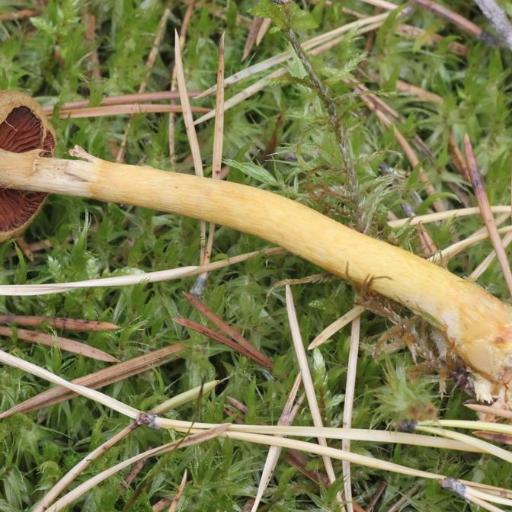
- 🩸 The Gills: This is the defining feature; the gills are a deep, cinnabar or blood-red color, providing a startling contrast to the drab cap.
- 🕸️ The Cortina: Like all webcaps, young specimens have a delicate, cobweb-like veil (the cortina) protecting the gills, which often leaves rusty spore deposits on the upper stem.
- 📉 The Stem: The stalk is typically pale yellow or chrome-yellow, sometimes displaying reddish tints near the base where it meets the soil.
🌲 Habitat & Ecology
- 🌲 Tree Partners: This mushroom is mycorrhizal, meaning it lives in a symbiotic relationship with trees. It is most commonly found under conifers like Pine and Spruce, though it occasionally appears near Birch.
- 🌿 Mossy Ground: It prefers acidic, nutrient-poor soils and is frequently spotted poking through thick carpets of moss or leaf litter during late summer and autumn.
⚠️ Safety & Toxicity
- 🚫 Status: STRICT WARNING: TOXIC. Like many members of the Cortinarius family, the Surprise Webcap is considered poisonous and should never be consumed.
- ☣️ The Danger: Many webcaps contain orellanine, a potent toxin that can cause permanent kidney failure. While this specific species is primarily used for dyeing wool, it is strictly "look but don't cook."
- 🧤 Handling: While touching the mushroom is generally safe, it is best to wash your hands after handling to avoid any accidental ingestion of spores or toxins.
✨ Fun Fact
The Surprise Webcap is a superstar in the world of "Mushroom Dyes." Despite its small size, the red gills are packed with anthraquinone pigments, which can dye sheep’s wool a brilliant, light-fast range of pinks, oranges, and deep "true" reds without the need for harsh chemicals!
More Details
| Hymenium Type | Lamella |
| Stipe Character | Cortina Stipe |
| Spore Print Color | Bordeaux |
| Mushroom Cap Shape | Campanulate Mushroom Cap |
| Hymenium Attachment | Adnate Hymenium Attachment |
| Mushroom Ecological Type | Mycorrhiza |







