Info
The Marsh Webcap is a striking, fiery jewel often found peeking through damp moss in the quiet corners of wetlands. Its vivid cinnabar or orange-red hues make it stand out against the grey-green of swampy landscapes, looking almost like a glowing ember dropped into the mud. In the hidden world beneath our feet, it acts as a loyal companion to willow trees, forming a complex partnership that helps both the fungus and the tree survive in oxygen-poor, waterlogged soils.
🔍 How to Identify
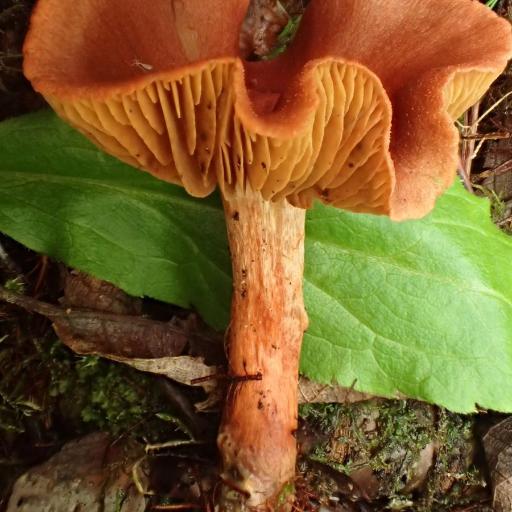
- 🍄 The Cap: Measuring 2 to 5 cm, the cap is typically bell-shaped or convex, often featuring a small, sharp bump (umbo) at the center. Its color is a brilliant, saturated orange-red that catches the light even on overcast days.
- 🕸️ The Cortina: True to its "Webcap" name, young specimens have a delicate, cobweb-like veil called a cortina that protects the gills. As the mushroom grows, this veil breaks, often leaving rusty-colored threads on the stem.
- 🍂 The Gills: The gills are broad and start as a bright orange, eventually turning a deep cinnamon or rusty brown as the spores mature and coat the surface.
- 🥢 The Stem: The stem is slender and slightly paler than the cap, usually yellowish-orange, and often decorated with fine, reddish fibers that look like tiny brushstrokes.
🌲 Habitat & Ecology
- 🌳 The Willow Bond: This mushroom is strictly "mycorrhizal" with Willow trees (Salix species). You will rarely find it far from a willow, as it exchanges nutrients with the tree's root system in a symbiotic embrace.
- 💧 Soggy Substrates: It thrives where most other mushrooms drown. Look for it in fens, marshes, and the edges of ponds, especially where Sphagnum moss creates a thick, spongy carpet.
- 📅 Seasonal Appearance: It is most commonly spotted during the late summer and throughout the autumn, popping up after heavy rains have saturated the ground.
⚠️ Safety & Toxicity
- ⚠️ STATUS: TOXIC / DO NOT CONSUME. The Cortinarius genus is one of the most dangerous groups of fungi for foragers.
- 🚫 The Danger: Many Webcaps contain orellanine, a potent toxin that causes delayed kidney failure. Symptoms can take days or even weeks to appear, making it incredibly difficult to treat.
- 🛑 Rule of Thumb: Never eat any mushroom that possesses a web-like veil and rusty-brown spores. The Marsh Webcap should be enjoyed only with the eyes and the camera lens.
✨ Fun Fact
✨ Latin Roots: Its species name, uliginosus, is derived from the Latin word for "marshy" or "swampy." It is a literal description of its home—a fungus that truly loves to have "wet feet!"
More Details