Info
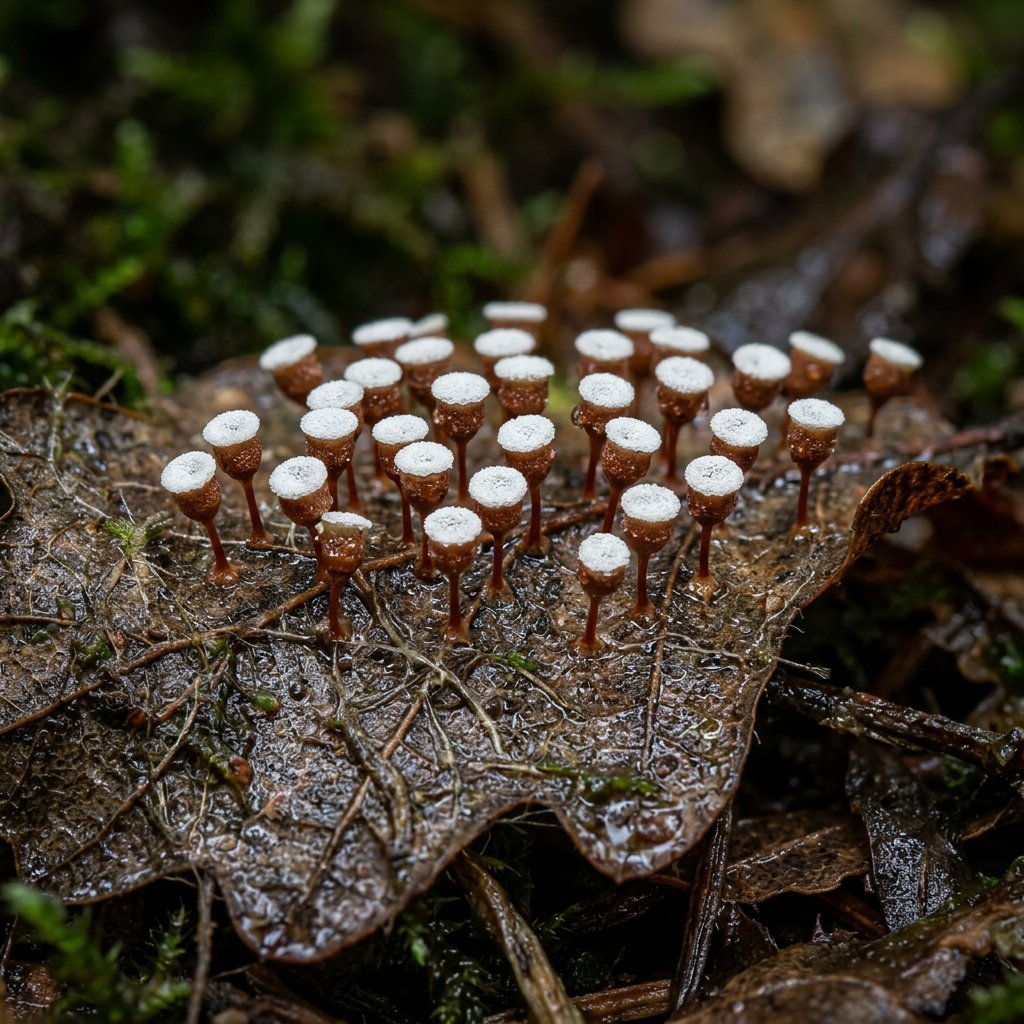
Often called the "Tiny Goblet," Craterium minutum looks like a collection of microscopic chalices forgotten by a woodland sprite. While it is frequently grouped with mushrooms, it is actually a Myxomycete—a fascinating slime mold that "crawls" as a single giant cell before settling down to form these ornate, rigid structures. You will likely find them dotting fallen leaves in damp, shaded corners of the forest, appearing like tiny golden ornaments.
🔍 How to Identify
- 🏆 The Goblet Shape: The most striking feature is the tiny, cup-like fruiting body (sporangium), which stands only 1 to 1.5 millimeters tall.
- 🎩 The Operculum: Each cup is covered by a distinct, flat "lid" that eventually pops off or disintegrates to allow the spores inside to escape.
- 🎨 Ochre Tones: These structures range in color from a pale, creamy yellow to a deep ochre or reddish-brown, often with a slightly glossy or waxy texture.
🌲 Habitat & Ecology
- 🍂 Leaf Litter Specialist: This species is a master of the forest floor, commonly found on decaying broadleaf litter, twigs, and sometimes even on old compost.
- 🦠 A Microscopic Hunter: Before it forms these cups, it lives as a "plasmodium"—a gelatinous mass that slowly moves across surfaces to engulf bacteria, fungal spores, and decaying organic matter.
⚠️ Safety & Toxicity
- 🚫 Status: NON-TOXIC. While not poisonous, Craterium minutum is not a food source. Due to its microscopic size and slime mold origin, it has no culinary value.
- ✋ Safe to Handle: It is perfectly safe to touch or observe closely, though it is very fragile. It poses no known risk to curious pets or children who might stumble upon it in the garden.
✨ Fun Fact
Slime molds like the Tiny Goblet are famous for their "primitive intelligence." Despite having no brain or nervous system, they can solve mazes and map out the most efficient routes to food sources—a feat that continues to baffle and inspire computer scientists!
More Details







