Info
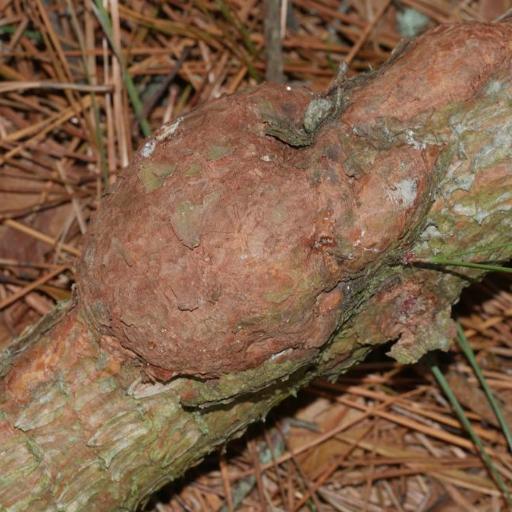
Known as the Pine-Oak Gall Rust, this fascinating fungus is a biological "shape-shifter" that lives a double life. Instead of the classic cap and stem, it manifests as woody swellings and vibrant orange dust. It is famous for its complex life cycle, which requires it to travel between two completely different hosts—pine trees and oak trees—to survive and reproduce.
🔍 How to Identify
- 🟠 The Pine Galls: On pine trees, look for distinct, golf-ball-sized woody swellings (galls) on branches or the main trunk. These are permanent "houses" for the fungus.
- ✨ Orange Spore Dust: In the spring, these woody galls crack open to reveal bright, "cheeto-orange" powdery spores that cover the bark like a neon velvet.
- 🍃 Oak Leaf Spots: On the underside of oak leaves, the fungus appears as tiny, hair-like structures or yellowish-orange spots that release spores back toward the pines.
🌲 Habitat & Ecology
- 🌳 Host Hopping: This fungus is "heteroecious," meaning it cannot finish its life cycle on just one tree. It spends its winters in the wood of pines and its summers on the leaves of oaks, using the wind to "commute" between them.
- 🪵 Persistence: Once it infects a pine branch, it stays there for the life of the tree. While it rarely kills large oaks, it can cause significant stress or limb breakage in young pine saplings by weakening the wood structure.
⚠️ Safety & Toxicity
- 🚫 WARNING: Non-Edible. Cronartium quercuum is a specialized plant pathogen and is not a culinary mushroom. Do not attempt to ingest the galls or the spores.
- 🐾 General Safety: It is not known to be toxic to pets or humans upon contact, though the fine orange spores can act as a mild respiratory irritant if inhaled in large quantities during a "bloom."
- 🌲 Plant Health: If you find this in your garden, it is a "foe" to your trees. It can stunt the growth of young pines and cause unsightly leaf drops on your oaks.
✨ Fun Fact
This fungus is a true master of complexity; it produces five different types of spores during its life cycle! Each spore type has a specific job, ranging from traveling miles in the wind to performing the fungal version of "mating" on the surface of a leaf.
More Details







