Info
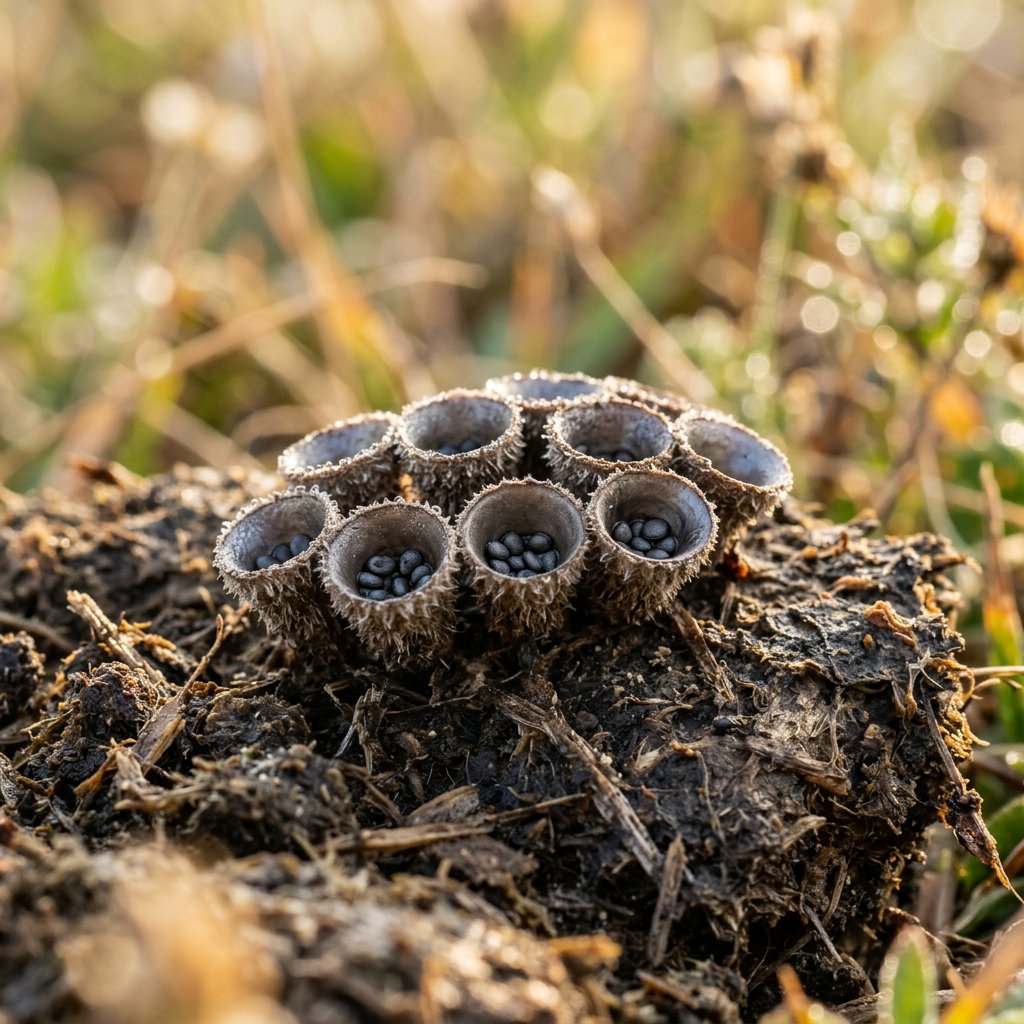
Often found tucked away in garden mulch or aged manure, Cyathus stercoreus looks like a tiny treasure chest meant for a woodland sprite. Commonly known as the Dung-loving Bird's Nest, this fungus is famous for its uncanny resemblance to a miniature nest filled with dark, shiny eggs. While it might look like a prop from a fairy tale, it is a master of "ballistic" engineering and a hardworking decomposer.
🔍 How to Identify
- 🧶 The "Nest" (Peridium): A small, vase-shaped cup (about 5–15mm tall) that is distinctly shaggy or hairy on the outside, appearing brownish-tan when young and darkening with age.
- 🍳 The "Eggs" (Peridioles): Inside the cup, you’ll find several flat, shiny, black discs. These are not seeds but "spore packets" that contain the fungus’s reproductive material.
- 🕳️ Inner Lining: The interior of the cup is smooth and lead-grey to blackish. This slick surface is crucial for helping the "eggs" slide out when hit by water.
🌲 Habitat & Ecology
- 💩 Nitrogen Lover: As the species name stercoreus (derived from the Latin word for dung) suggests, this fungus thrives on herbivore manure. However, it is also frequently spotted in gardens on wood chips, mulch, or soil enriched with fertilizer.
- 💧 Splash-Cup Physics: This mushroom doesn't use wind to spread spores. Instead, it uses a "splash-cup" mechanism. When a single raindrop hits the angled side of the cup, the force ejects the "eggs" up to several feet away from the parent nest.
⚠️ Safety & Toxicity
- 🛑 WARNING: Cyathus stercoreus is considered inedible.
- 👅 Texture & Taste: Because of its tiny size and tough, leathery, or "wood-like" texture, there is no culinary value.
- 🐾 Garden Safety: It is not known to be toxic to pets or children if touched. However, because it grows on manure and decaying organic matter, always ensure hands are washed after handling to avoid contact with bacteria from the soil or substrate.
✨ Fun Fact
The "eggs" are attached to the nest by a tiny, invisible cord called a funiculus. When a raindrop launches the egg, this cord uncoils like a bungee line. As the egg flies through the air, the sticky cord catches onto a blade of grass or a twig, wrapping around it like a tetherball so the spores stay exactly where the fungus wants them!
More Details







