Info
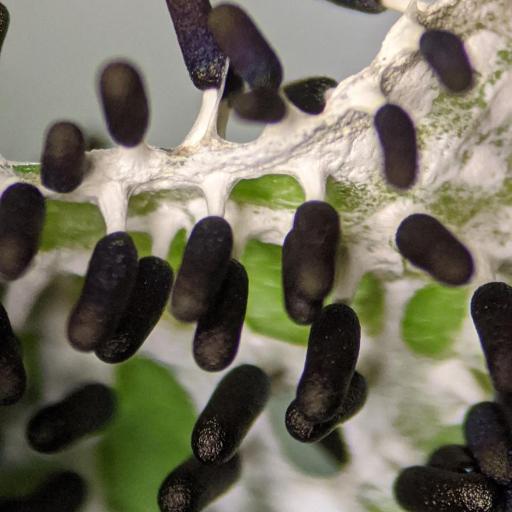
Often called the "White-footed Slime Mold," Diachea leucopodia looks like a miniature colony of metallic matchsticks rising from the forest floor. While it is categorized with fungi, it is actually a Myxomycete—a fascinating "slime mold" that spends part of its life "crawling" as a single giant cell before transforming into these shimmering, stationary structures. Its alien-like appearance makes it a favorite find for macro-photographers and nature enthusiasts.
🔍 How to Identify
- ✨ The Cap (Sporangium): These tiny, cylindrical capsules display a brilliant metallic iridescence, shimmering with hues of deep purple, electric blue, or bronze.
- ☁️ The Stalk: The most defining feature is the stark, chalk-white stem that supports the dark cap, making the organism look like it is wearing tiny white boots.
- 🌿 Growth Pattern: It appears in dense, gregarious clusters, often "climbing" up the stems of living plants, fallen leaves, or even garden mulch.
🌲 Habitat & Ecology
- 🏃 The Great Migration: Before it takes this beautiful form, it exists as a "plasmodium"—a creeping, translucent white mass that moves across damp surfaces to find the perfect spot to fruit.
- 🍂 Garden Guest: You will most likely spot it in late summer or autumn in damp, shaded garden beds, often appearing overnight on strawberry leaves, ivy, or damp wood chips.
⚠️ Safety & Toxicity
- 🛑 WARNING: While not known to be poisonous, Diachea leucopodia is not edible. Its tiny size and brittle texture make it of no culinary interest, and its spores can occasionally trigger mild allergies in sensitive individuals.
- 🐾 Pet & Plant Safety: It is harmless to pets and is not a plant parasite. Even if it covers a leaf, it is only using the plant as a "ladder" to reach better airflow and does not harm the foliage.
✨ Fun Fact
Slime molds like Diachea are famous for their biological "intelligence." Scientists have proven that in their crawling stage, they can solve mazes and find the most efficient routes between food sources—all without having a single brain cell!
More Details