Info
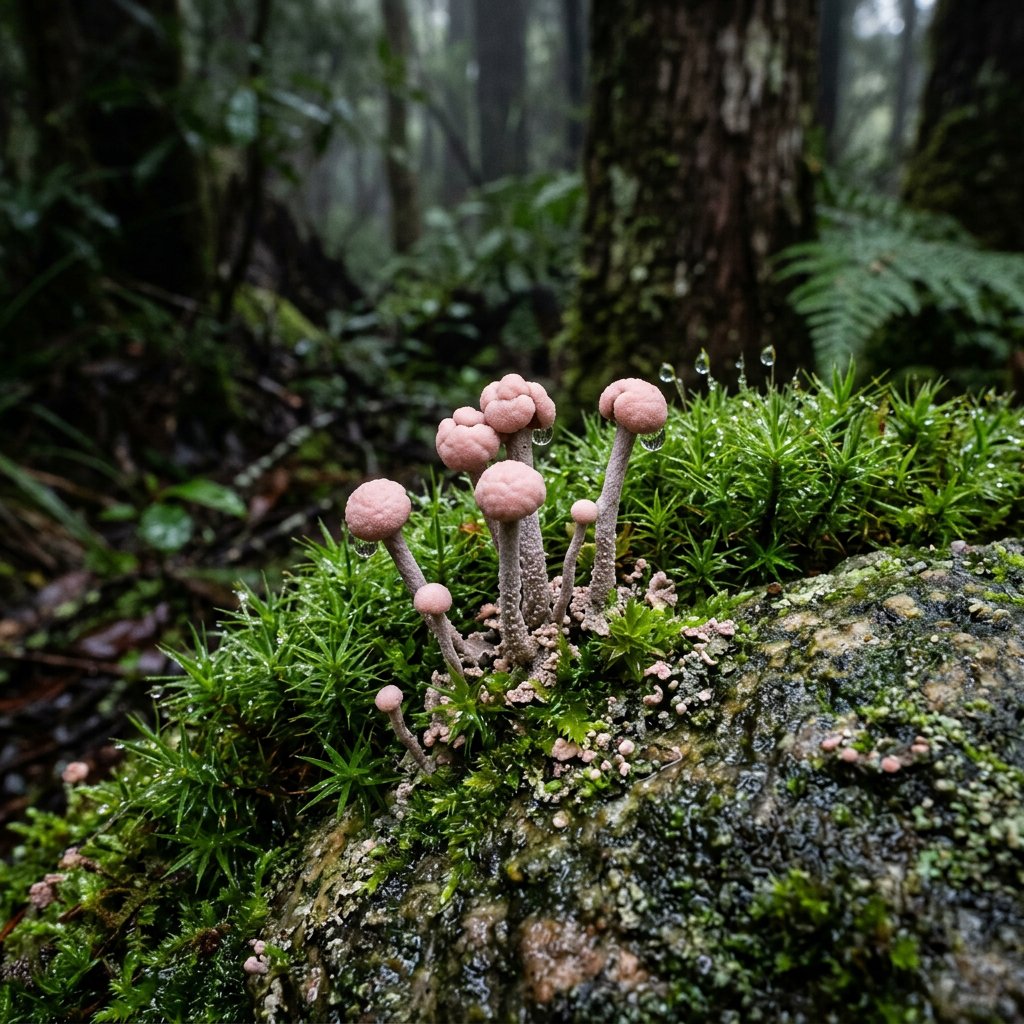
Known as the "Pink Earth Lichen," Dibaeis arcuata is a charming example of nature’s miniature architecture. It looks like a forest of tiny pink lollipops or alien pins emerging from a minty-green crust. While it belongs to the fungi kingdom, it is actually a lichen—a unique partnership between a fungus and an alga working together to colonize bare earth.
🔍 How to Identify
- 🌸 The Fruiting Bodies: Known as apothecia, these are the most striking feature. They look like tiny, rounded buttons or globes that range from pale rose to a fleshy salmon-pink color.
- 🤍 The Stems: Each pink head sits atop a short, sturdy, translucent or white stalk (podetium) that lifts the spores away from the ground.
- 🟢 The Crust (Thallus): Unlike traditional mushrooms that sprout from soil, these emerge from a flat, granular, mint-green or greyish crust that spreads over the ground like a textured carpet.
🌲 Habitat & Ecology
- 🛣️ The Pioneer: You will most likely spot these on "disturbed" ground. They love clay banks, road cuts, and the sides of forest trails where the topsoil has been moved, leaving bare earth exposed.
- 🤝 The Symbiosis: As a lichenized fungus, it doesn't "eat" decaying wood. Instead, the green algae living inside its crusty base provide energy through photosynthesis, while the fungus provides the structure and protection.
⚠️ Safety & Toxicity
- 🚫 Status: NOT EDIBLE. While Dibaeis arcuata does not carry the "death cap" reputation of some gilled mushrooms, it is not a food source and has no culinary use.
- 🐾 Details: It is generally safe to touch, making it a favorite for nature photographers. However, keep curious pets and children from "grazing" on them; like most lichens, they contain acids that can cause mild digestive irritation if swallowed.
✨ Fun Fact
Because they grow so slowly and prefer unstable soil, a patch of Pink Earth Lichen is often the first sign of life returning to a barren area. In some circles, they are called "Fairy Pins," and seeing a hillside covered in them can feel like walking into a scene from a fantasy novel.
More Details