Info
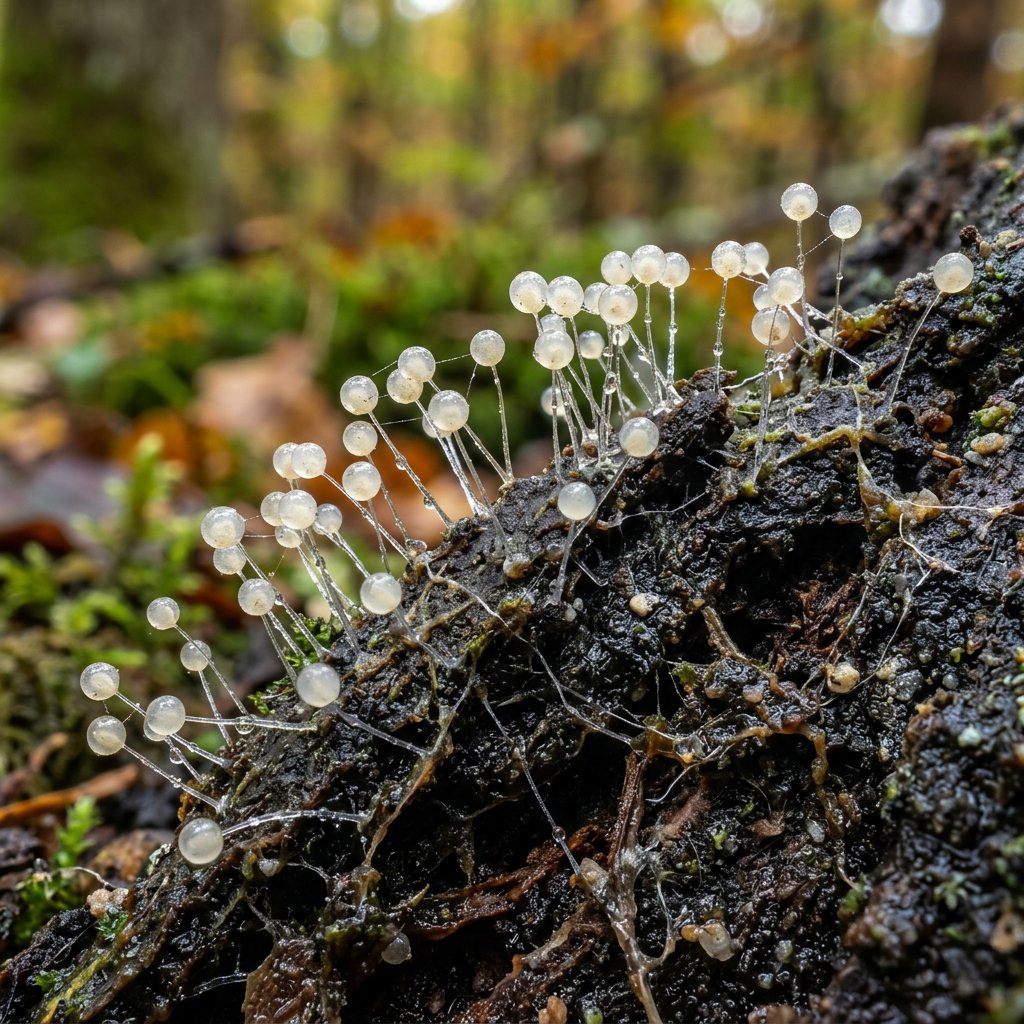
Often called a "Micro-Pin," Echinostelium paucifilum is a hidden gem of the forest floor. It isn't actually a mushroom in the traditional sense, but a slime mold (Myxomycete). These tiny organisms are the "shapeshifters" of the woods, spending part of their lives as a creeping, jelly-like mass before transforming into these delicate, glass-like structures that look like something out of a sci-fi film.
🔍 How to Identify
- 📍 Microscopic Stature: These are incredibly small, usually less than 0.5mm tall. You will likely need a magnifying glass or a macro lens to see them clearly.
- 💎 Crystalline Stalk: The "stem" is hair-thin and translucent, often appearing like a tiny shard of glass or a strand of spider silk standing upright.
- ⚪ The Spore Globe: At the top of the stalk sits a tiny, spherical head (sporangium) that is typically white, pale pink, or silver, which eventually breaks open to release spores.
🌲 Habitat & Ecology
- 🌳 Bark Specialist: You won’t find these in the soil. They specifically love the bark of living trees (especially Junipers and Apple trees) or decaying wood where they can hunt for their dinner.
- 🦠 The Bacteria Hunter: Before it looks like a tiny pin, it lives as a "plasmodium"—a single-celled blob that moves across surfaces to eat bacteria and yeast, acting as a microscopic janitor for the tree's surface.
⚠️ Safety & Toxicity
- 🛑 WARNING: While slime molds are not known to be toxic to humans, they are not edible. Because of their microscopic size, they have no culinary value, and their chemical composition is not meant for consumption.
- 🐾 Pet Safety: They are generally harmless to pets and children if touched, though they are far too small to be a choking hazard or a significant ingestion risk.
✨ Fun Fact
Despite looking like plants or fungi, slime molds like Echinostelium are more closely related to amoebas! They are capable of "learning" and finding the shortest path to food, despite having no brain or nervous system.
More Details







