Info
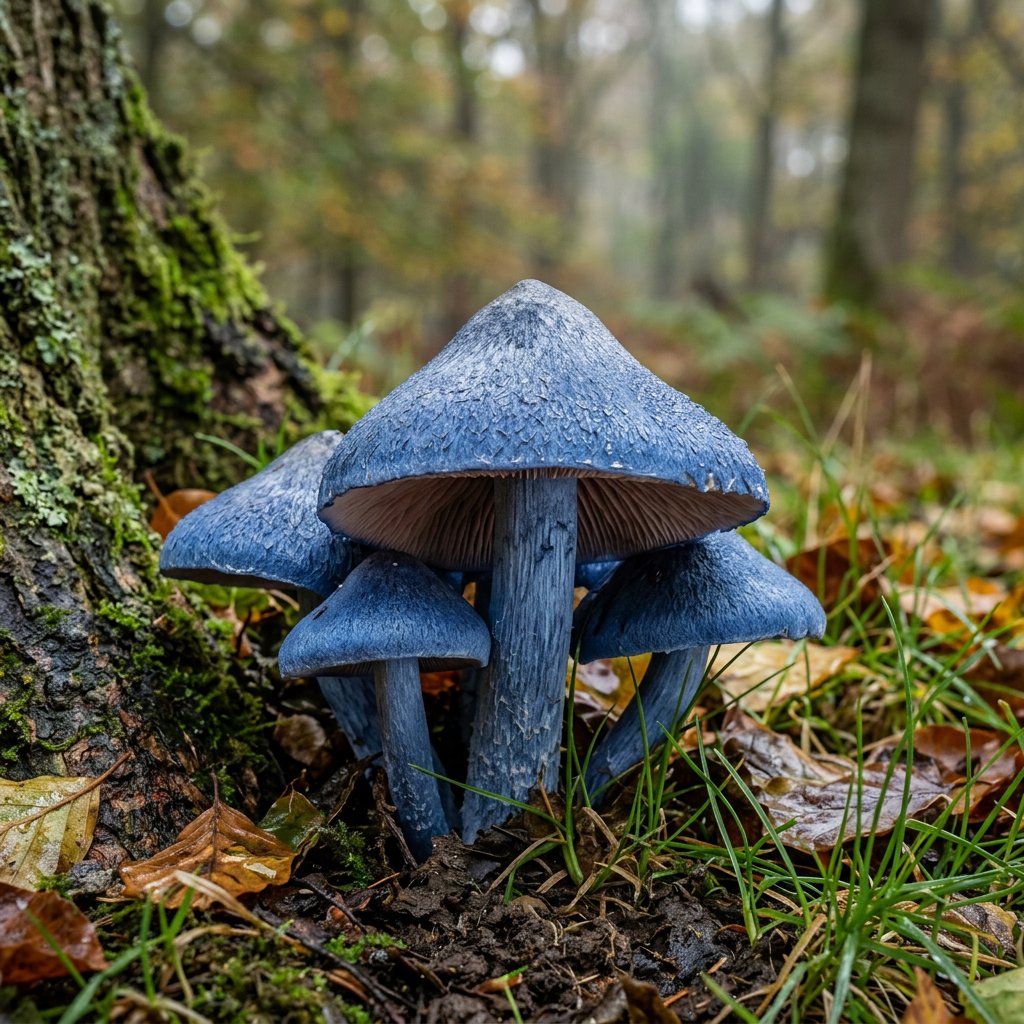
Known as the "Big Blue Pinkgill," this mushroom is a rare and striking jewel often found hiding in ancient, undisturbed meadows. Its deep, steely-blue color looks almost otherworldly against the green grass, earning it a reputation among foragers as a "trophy find." In European folklore, such vibrant mushrooms were often seen as markers of healthy, magical landscapes that had escaped the plow for centuries.
🔍 How to Identify
- 🟦 The Cap: Large and fleshy, ranging from 4 to 10 cm across. It starts as a blunt cone and flattens with age, showcasing a beautiful indigo or grayish-blue color with a silky, fibrillose texture.
- 🌸 The Gills: Initially pale or white, the gills eventually turn a distinct salmon-pink as the spores mature. This "pinkgill" trait is the hallmark of the Entoloma genus.
- 👔 The Stem: Thick, solid, and sturdy. It usually matches the cap’s blue hue but may have a silvery sheen or white base, appearing slightly "streaky" or fibrous.
🌲 Habitat & Ecology
- 🌱 Ancient Grasslands: This mushroom is an "indicator species" for unimproved, ancient grasslands and churchyards. It hates artificial fertilizers and disappears quickly if the land is disturbed by modern farming.
- 🤝 Ecological Role: While its exact relationship with the soil is complex, it is often found alongside "Waxcaps," suggesting it thrives in nutrient-poor, mossy environments that haven't been tilled for decades.
⚠️ Safety & Toxicity
- 🚨 WARNING: While some older guides list the Big Blue Pinkgill as edible, it is strongly advised not to consume it. Many members of the Entoloma family are dangerously toxic, causing severe gastrointestinal distress.
- 🛑 Conservation Status: Because it is increasingly rare and threatened by habitat loss across Europe and the UK, picking it for the table is discouraged to allow the spores to spread and preserve the population.
- 🐾 Pets & Kids: Keep curious pets away, as the ingestion of blue Entoloma species can lead to vomiting and dehydration.
✨ Fun Fact
The Entoloma bloxamii was named in honor of Andrew Bloxam, a 19th-century English naturalist who originally sailed on the HMS Blonde. He transitioned from exploring exotic islands to documenting the quiet, "blue" wonders of his local English countryside!
More Details
| Hymenium Type | Lamella |
| Stipe Character | Bare Stipe |
| Spore Print Color | Pink |
| Hymenium Attachment | Adnexed Hymenium Attachment |







