Info
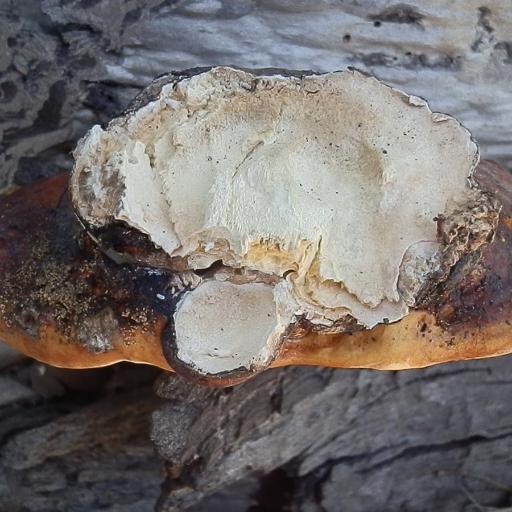
Often referred to as the Western Red-Belted Polypore, Fomitopsis schrenkii is a silent architect of the forest. This woody, shelf-like fungus acts as a long-term tenant on evergreen trees, recognizable by its striking "racing stripe" of bright orange or red. While it lacks the delicate beauty of a wildflower, its presence is a vital sign of the forest's natural recycling process.
🔍 How to Identify
- 🪵 The Texture: The body is hard, woody, and perennial. It doesn't wither away like a typical mushroom; instead, it grows tougher and more cork-like with age.
- 🎨 The "Belt": The most distinct feature is a vibrant band of orange, red, or resinous brown near the outer margin, contrasting against a darker, grayish-black center.
- 🕳️ The Underside: Unlike common mushrooms with gills, this fungus has a pale, creamy-white pore surface. These pores are where it releases its spores, and they do not turn blue or dark when bruised.
🌲 Habitat & Ecology
- 🌲 Conifer Companion: You will almost exclusively find this mushroom on coniferous trees, especially Spruce and Fir. It is a master of "brown rot," breaking down the tough cellulose of wood and returning nutrients to the soil.
- 🕰️ A Forest Record-Keeper: Because it is perennial, it grows a new layer of pores every year. If you were to slice one open, you could see growth rings similar to those inside a tree trunk, marking the seasons it has survived.
⚠️ Safety & Toxicity
- 🚫 WARNING: While not considered "deadly poisonous" like some of its forest cousins, Fomitopsis schrenkii is strictly INEDIBLE.
- 🦷 Dental Hazard: The mushroom is as hard as the wood it grows on. Attempting to eat it would be like chewing on a piece of mahogany. It is far better suited for photography than the dinner plate.
- 🐾 Pet Safety: While generally ignored by animals due to its woody texture, keep an eye on curious dogs who might try to use a fallen specimen as a chew toy, as it can cause digestive blockages.
✨ Fun Fact
When these mushrooms are actively growing in humid conditions, they perform a process called guttation. They "sweat" tiny, glistening droplets of clear or amber liquid from their underside, making it look like the mushroom is decorated with forest jewels!
More Details