Info
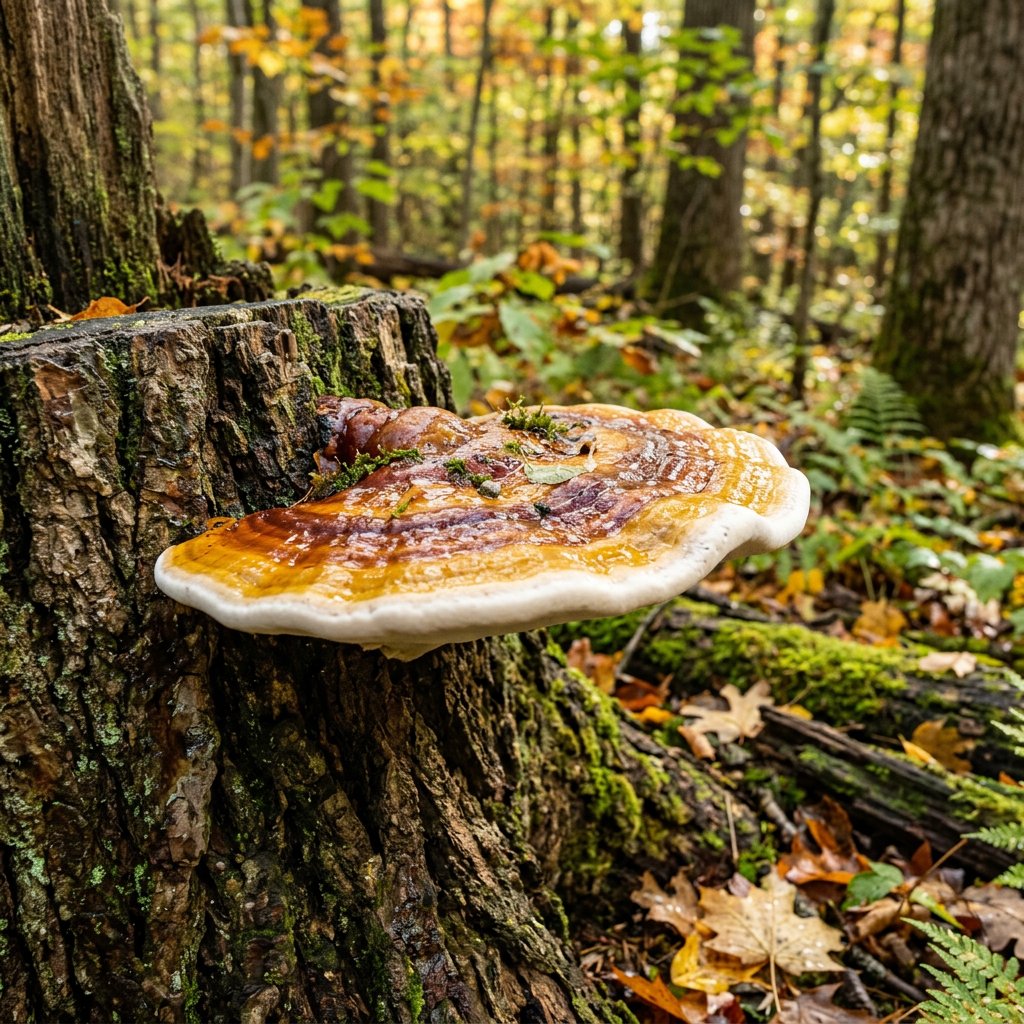
Often referred to as the "Golden Reishi," Ganoderma curtisii is a stunning, lacquered beauty found throughout the eastern United States. While its famous cousin, the Lingzhi (Ganoderma lucidum), dominates Eastern folklore, this North American relative is a local legend in its own right. Often appearing as if it has been dipped in a vat of shiny, high-gloss varnish, it stands out against the muted tones of the forest floor like a piece of organic sculpture.
🔍 How to Identify
- 🎨 The Cap: Displays a brilliant, "varnished" surface that transitions through shades of creamy yellow, ochre, and deep reddish-brown. It often has distinct concentric growth rings.
- 🪵 The Stem (Stipe): Unlike many other "shelf" fungi, this species usually has a distinct, tough, and woody stem that can be central or attached to the side, looking much like a polished mahogany branch.
- 🧽 The Pores: The underside features tiny, white-to-pale-buff pores rather than gills. If you press your thumb into them, they will slowly bruise a dull brown.
- ✨ The Texture: When young, the edges are soft and white, but as it matures, the entire body becomes extremely corky, tough, and eventually wood-like.
🌲 Habitat & Ecology
- 🌳 Hardwood Lover: You will most often find this mushroom growing at the base of decaying hardwood trees, with a very strong preference for Oak and occasionally Maple.
- 🍂 The Recycler: As a saprobic fungus, it plays a vital role in the ecosystem by breaking down tough lignin in dead wood, returning essential nutrients to the soil to feed the next generation of trees.
- 🌦️ Seasonal Appearance: It typically fruits from early summer through autumn, often appearing after heavy rains in humid, forested environments.
⚠️ Safety & Toxicity
- ❗ WARNING: Never consume any wild mushroom unless you are 100% certain of its identity. Many Ganoderma species look nearly identical and require microscopic analysis to differentiate.
- 🍵 Edibility: While not "poisonous" in the traditional sense, Ganoderma curtisii is far too woody and tough to eat as food. It is traditionally sliced and steeped into bitter medicinal teas or tinctures.
- 🐕 Pets: While not considered high-risk, the tough, fibrous nature of the mushroom can cause digestive blockages or upset if chewed on by curious dogs.
✨ Fun Fact
The shiny, "varnished" look of the cap is caused by a thick layer of resinous crust. In the sunlight, this layer acts like a natural shellac, protecting the mushroom from drying out and giving it its signature "wet paint" appearance even in dry weather!
More Details
| Hymenium Type | Pores |
| Stipe Character | Bare Stipe |
| Spore Print Color | Brown |
| Hymenium Attachment | Decurrent Hymenium Attachment |
| Mushroom Ecological Type | Saprobiont |







