Info
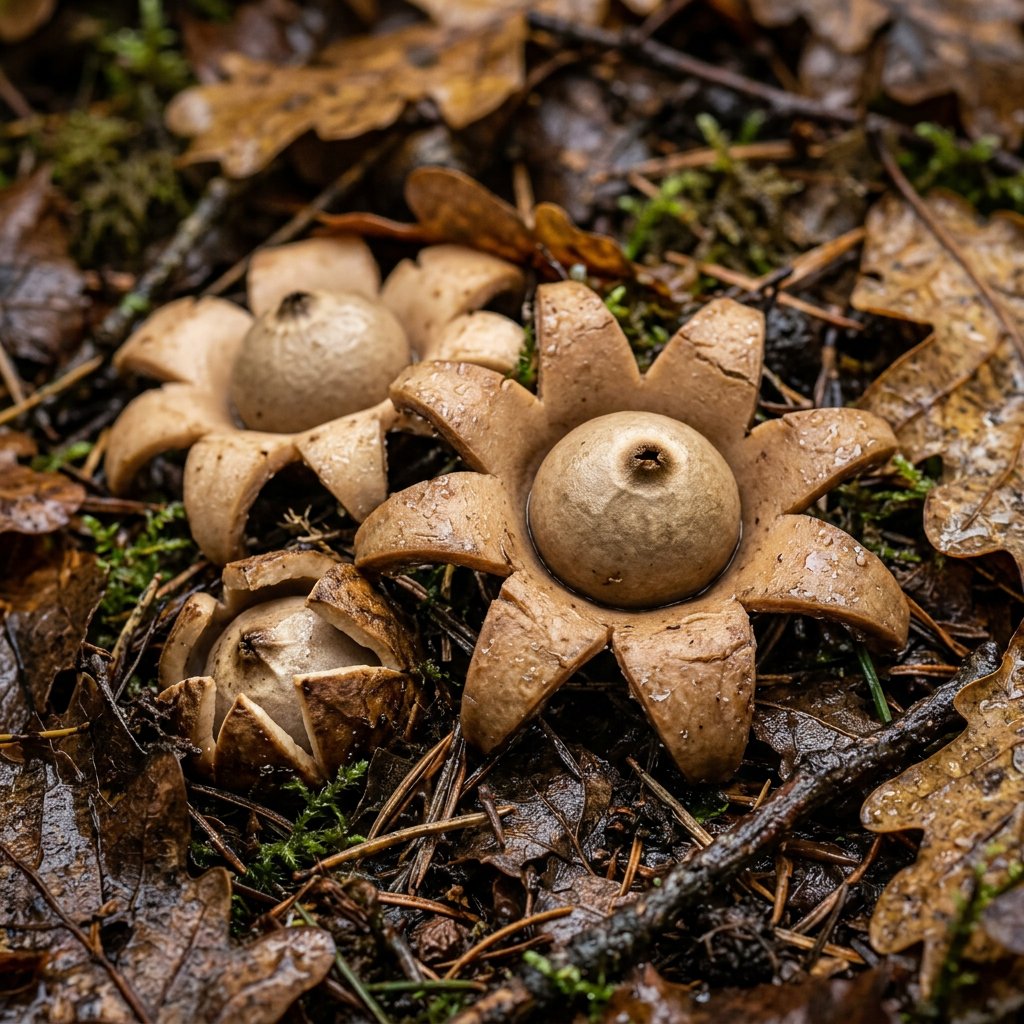
Often called the Sessile Earthstar, this mushroom looks like a celestial body that has fallen and taken root in the forest floor. In various folklores, Earthstars were sometimes seen as "fallen stars" or omens of changing weather. Their unique, geometric shape makes them one of the most easily recognized and enchanting finds for hikers and foragers alike.
🔍 How to Identify
- 🌟 The Star Rays: The outer skin (exoperidium) splits into 4 to 9 pointed "petals" or rays that curve backward, lifting the central body slightly off the ground.
- 🎈 Central Spore Case: A smooth, globe-shaped puffball sits nestled in the center of the star. It is usually a pale tan, cream, or light brown color.
- 👄 The Beak (Ostiole): At the very top of the central globe is a small, fuzzy-edged hole. This is the exit point for the spores and is often surrounded by a distinct, lighter-colored ring.
🌲 Habitat & Ecology
- 🍂 Forest Floor Scavenger: These mushrooms are saprobic, meaning they break down dead organic matter. Look for them tucked away in the leaf litter of deciduous or mixed woods, often near rotting logs.
- 🌧️ Hydraulic Movement: The Earthstar is sensitive to moisture. In some related species, the rays can actually fold up when dry and unfold when wet, though Geastrum saccatum generally keeps its star shape once it has matured and "bloomed."
- 💨 Rain-Drop Bellows: This mushroom uses "impact dispersal." When a heavy raindrop hits the central puffball, it acts like a bellows, puffing a cloud of microscopic brown spores out through the top hole.
⚠️ Safety & Toxicity
- 🚫 WARNING: While the Sessile Earthstar is not known to be lethally poisonous, it is considered inedible.
- 👅 Texture & Taste: The flesh is incredibly tough, leathery, and bitter. It provides zero culinary value and could cause significant digestive distress if consumed by humans or curious pets.
- 🌬️ Spore Irritation: While generally safe to observe, avoid squeezing the puffball directly into your face, as the concentrated spore dust can irritate the lungs or eyes.
✨ Fun Fact
The name Geastrum literally translates to "Earth Star," but the species name saccatum means "sac-like," referring to the way the central spore case is partially enclosed by the base of the star's rays before they fully spread out!
More Details







