Info
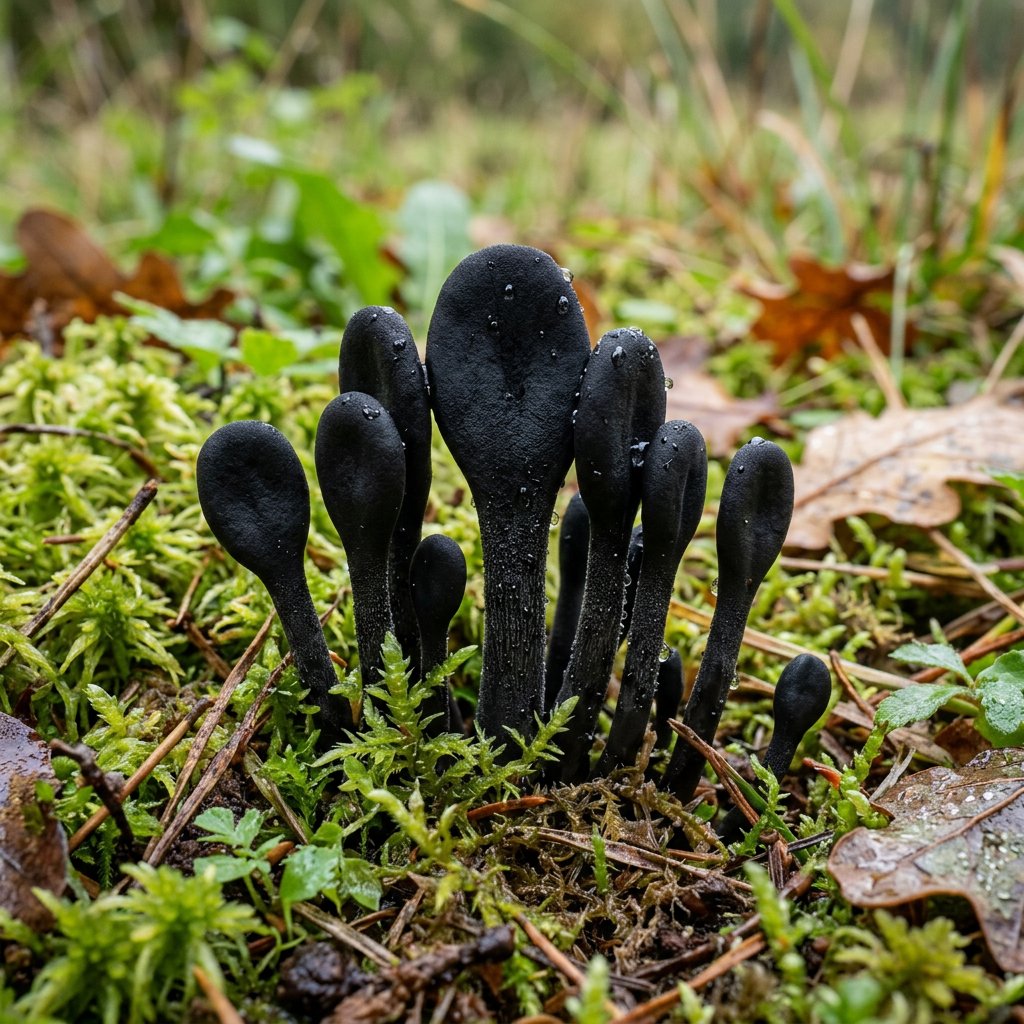
Commonly known as Cooke’s Earthtongue, this mushroom looks like a mysterious, charred finger reaching out from the soil. Unlike typical "umbrella" mushrooms, it belongs to a group of fungi that evolved into a club-like shape, often found nestled among moss or short grass. In folklore, these dark protrusions were sometimes imagined as the tongues of spirits or the earth itself trying to speak.
🔍 How to Identify
- 👅 The Head: The upper part (the "tongue") is dry, black, and distinctively club-shaped or slightly flattened. It lacks the slimy texture found in some of its close relatives.
- 🖋️ The Stem: The stalk is brownish-black and often has a slightly different texture than the head, sometimes appearing finely velvety or scaly under a magnifying glass.
- 📏 Size & Shape: They are quite small, usually reaching only 3 to 7 centimeters in height, making them easy to miss unless you are looking closely at the ground.
🌲 Habitat & Ecology
- 🌱 Ancient Grasslands: This species is a "bio-indicator," meaning it only thrives in old, unimproved grasslands that haven't been disturbed by modern fertilizers or plowing.
- 🤝 Mossy Neighbors: You will almost always find it growing among mosses or in coastal sand dunes, often appearing in late autumn when the air turns crisp and damp.
- 🍂 The Decomposer: As a saprobic fungus, it plays a vital role in the ecosystem by breaking down organic matter in the soil, recycling nutrients back into the earth.
⚠️ Safety & Toxicity
- 🚫 WARNING: Inedible. While not widely documented as "deadly," Cooke’s Earthtongue has a tough, leathery texture and no culinary value.
- 🛑 Lookalike Risk: Many black earthtongues look identical to the naked eye and can only be told apart with a microscope. Some related species may cause gastric upset, so it is best to enjoy this fungus purely for its visual mystery.
- 🐾 Pets & Kids: Keep curious pets away; while not a high-risk toxin, consuming raw wild fungi can cause unpredictable digestive distress in animals.
✨ Fun Fact
Earthtongues are often found alongside Waxcaps (brightly colored, jewel-like mushrooms). Together, they form the "CHEG" group of fungi, which mycologists use to identify high-conservation-value habitats—essentially, if you find this mushroom, you are standing in a very healthy, ancient ecosystem!
More Details







